

Epidemiology(Epidemiol.)_流行病学
Time:2026-03-08 Visits:1
Epidemiology Major
The Epidemiology Major is dedicated to studying the distribution patterns and influencing factors of diseases and health states within populations, providing the scientific basis for disease prevention and health promotion. Its curriculum integrates biostatistics, research design, and data analysis, cultivating students' core competencies in diverse fields such as disease surveillance, outbreak investigation, health policy evaluation, and clinical research. Exploring the Epidemiology Major is a key pathway to becoming a vital professional who bridges medical evidence, data analysis, and public health action.

1. Introduction to the Epidemiology Major
Epidemiology is a core methodological discipline within public health and an applied science. It studies the distribution patterns of diseases, health conditions, and their influencing factors within specific populations, applying these findings to prevent and control diseases while promote health. Its core lies in employing scientific research designs, systematic data collection, and rigorous statistical analysis to uncover the causes of health issues, predict their trends, and provide evidence-based support for public health decision-making. This major cultivates interdisciplinary professionals with a solid foundation in statistics, a keen public health perspective, and strong analytical capabilities, serving as a bridge connecting medicine, data, and public policy.
2. Major Courses in the Epidemiology Major
| Module Category | Core Courses |
| Theoretical Foundations | Principles of Epidemiology, Health Statistics, Biostatistics, Introduction to Public Health, Fundamentals of Infectious Disease |
| Core Methodology | Epidemiological Research Design (Observational Studies, Experimental Studies), Epidemiological Data Analysis, Advanced Statistical Modeling (e.g., Survival Analysis, Multilevel Models), Causal Inference Methods |
| Domain Epidemiology | Epidemiology of Infectious Diseases, Epidemiology of Chronic Non-Communicable Diseases, Environmental Epidemiology, Occupational Epidemiology, Nutritional Epidemiology, Molecular and Genetic Epidemiology, Social and Behavioral Epidemiology |
| Tools and Skills | Statistical Software Applications (R/SAS/Stata), Data Management and Database Techniques, Application of Geographic Information Systems in Health, Systematic Reviews and Meta-Analysis, Questionnaire Design |
| Related Disciplines | Global Health, Health Economics, Health Policy and Management, Social Medicine, Health Education and Promotion, Environmental Health Sciences |
| Practice and Frontiers | Field Epidemiology (Outbreak Investigation), Public Health Surveillance and Early Warning, Health Big Data Analysis, Application of Artificial Intelligence in Public Health, Epidemiological Case Studies, Professional Internship |
3. Advanced Study Pathways for the Epidemiology Major
Master's/Doctorate in Epidemiology and Biostatistics: To become a methodology expert, specializing in advanced statistical modeling, causal inference, or research in specific disease domains.
Master's/Doctorate in Public Health: To deepen expertise in the broader field of public health, with options such as health policy or global health.
Master's/Doctorate in Clinical Research: To focus on the design, management, and analysis of clinical trials for drug and medical device development.
Master's in Data Science/Bioinformatics: To transition into frontier interdisciplinary areas such as health big data and genomic data analysis.
Master's in Health Economics/Policy Analysis: To apply epidemiological evidence to health resource assessment and policy formulation.

4. Career Paths and Positions for the Epidemiology Major
Graduates of the Epidemiology Major enjoy broad career prospects, with demand spanning from traditional disease control to emerging health technology sectors.
| Core Employment Sectors | Typical Positions | Primary Responsibilities |
| Government & Disease Control Systems | CDC Epidemiological Investigator/Specialist | Disease surveillance, on-site outbreak investigation, development and evaluation of prevention and control strategies |
| Administrative Officials (e.g., Health Commission) | Public health policy research and formulation, project management, performance evaluation | |
| International & Non-Governmental Organizations | Project Officer (e.g., WHO, UNICEF) | Design, implementation, monitoring, and evaluation of global or regional health programs |
| Research or Program Specialist (e.g., Gates Foundation) | Scientific review and impact assessment of funded projects | |
| Research Institutes & Universities | Researcher, University Faculty | Undertake research projects; engage in epidemiology teaching and academic research |
| Healthcare Institutions | Hospital Infection Control Specialist | Surveillance, prevention, control, and management of healthcare-associated infections |
| Clinical Research Center Data Analyst | Responsible for data management and statistical analysis for clinical trials or clinical studies | |
| Pharmaceutical & Medical Device Industry | Pharmacoepidemiologist / Drug Safety Specialist | Monitoring and evaluating the safety and risk-benefit profile of post-marketing drugs |
| Clinical Research Manager / Biostatistician | Designing clinical trial protocols, conducting statistical analysis and reporting | |
| Health Technology & Consulting Firms | Health Data Analyst / Data Scientist | Utilizing healthcare big data for disease prediction, health services research, etc. |
| Public Health Consultant | Providing health risk assessment, program evaluation, and advisory services to governments or corporations |
5. Employment Rate and Industry Trends for the Epidemiology Major
Employment Rate Characteristics
“Growing Demand, Expanding Fields”: Especially following global public health events, government and societal demand for talent in this field has increased significantly and remains sustained. Beyond traditional disease control positions, new roles continue to emerge in the pharmaceutical, health tech, consulting, and other industries.
“Heavy Reliance on Skills and Qualifications”: A master's degree or higher is the mainstream requirement for entry into core research, analysis, and management positions. Quantitative analysis skills are the core competitive advantage in job seeking.
“Value-Driven, Significant Salary Variation”: Position salaries vary considerably between government systems, international organizations, academia, and the industry. Pharmaceutical and health technology companies typically offer higher compensation.
Industry Development Trends
Data-Driven Precision Prevention: The integrated analysis of multi-source big data (e.g., electronic health records, genomic data, environmental monitoring, mobile device data) is advancing epidemiological research towards more precise risk prediction and personalized prevention.
Global Health Security as the New Normal: Monitoring and responding to transnational threats such as emerging infectious diseases, antimicrobial resistance, and the health impacts of climate change have become long-term priority tasks.
Artificial Intelligence and Computational Epidemiology: AI and complex network models are widely applied in epidemic simulation and forecasting, disease transmission dynamics research, and automated surveillance and early warning systems.
From Etiological Research to Policy Translation: Increased emphasis is placed on efficiently and transparently translating epidemiological evidence into actionable public health interventions and health policies, underscoring implementation science and impact evaluation.
Life Course and Health Equity: The research perspective is shifting from single diseases to health trajectories across the entire life course, with greater focus on the social determinants of health and a commitment to eliminating health inequalities.
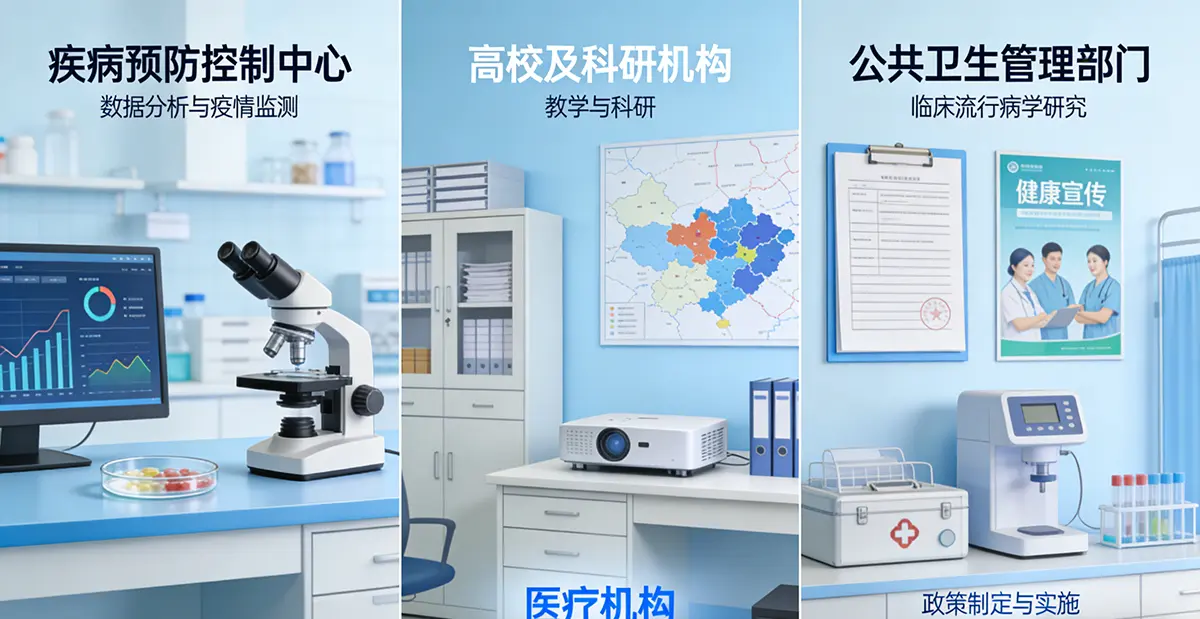
6. Leading Global Institutions for the Epidemiology Major
Epidemiology is typically offered as a core major within schools of public health.
Country/Region | Representative Institutions (Top Institutions in Epidemiology/Public Health)
United States | Johns Hopkins University (Bloomberg School of Public Health), Harvard University (T.H. Chan School of Public Health), University of North Carolina at Chapel Hill (Gillings School of Global Public Health), Columbia University (Mailman School of Public Health)
United Kingdom | London School of Hygiene & Tropical Medicine (notable specialization), University of Oxford, University of Cambridge, Imperial College London
Europe | Karolinska Institutet (Sweden), Utrecht University (Netherlands), University of Zurich (Switzerland)
Canada | University of Toronto (Dalla Lana School of Public Health), McGill University
Australia | University of Sydney, University of Melbourne
Asia | The University of Hong Kong (Li Ka Shing Faculty of Medicine, School of Public Health), National University of Singapore (Saw Swee Hock School of Public Health), The University of Tokyo (Graduate School of Public Health)
China | Peking University (School of Public Health), Fudan University (School of Public Health), Huazhong University of Science and Technology (School of Public Health), Chinese Center for Disease Control and Prevention (Graduate School)
7. DisciplineMajor Recommendations
Ideal Candidates for the Epidemiology Major
Individuals with a strong curiosity about exploring the social, environmental, and behavioral patterns underlying disease and health.
Those who possess excellent logical thinking, rigor, and sensitivity to numbers, and are not intimidated by in-depth quantitative analysis.
Individuals with a strong sense of social responsibility, concerned with population health and equity, and who wish their research to translate into tangible societal benefits.
Those with good communication skills, capable of clearly conveying complex scientific findings to policymakers, peers, and the public.
Core Competencies of the Epidemiology Major
Methodological Expertise: Mastery of the complete scientific methodology from research design and data collection to advanced statistical analysis.
Data Insight: The ability to extract meaningful signals and causal evidence about health issues from complex, noisy data.
Interdisciplinary Integration: The capacity to understand and integrate knowledge from multiple disciplines such as medicine, sociology, statistics, and economics.
Policy and Communication Skills: Knowing how to “translate” scientific evidence into policy recommendations and public health messages.
Study Recommendations for the Epidemiology Major
Solidify the Foundation in Mathematics and Statistics: It is essential to master advanced mathematics, probability theory, and mathematical statistics during undergraduate studies, and to become proficient in at least one statistical programming language (R or Python).
Actively Participate in Practical Experience: Seek internship opportunities at disease control centers, research projects, or international organizations to apply theory to real-world public health problems.
Cultivate a “Macro-Micro” Perspective: Develop both a macro-level understanding of public health systems and the ability to delve into the micro-level mechanisms of specific diseases or health issues.
Stay Abreast of Technological Frontiers: Proactively learn new tools and methods such as big data processing, machine learning, and GIS spatial analysis.
Plan a Clear Career Path: Determine whether your future inclines more towards academic research, government application, or industry development, and choose suitable advanced study directions and skill sets accordingly.
*Note: Some institutions may categorize this major under different disciplines. Please refer to the specific classification used by the institution.*
- The Previous Passage:Clinical and Health Sciences(Clin. Health Sci.)_临床与健康
- The Next Passage:Agricultural Sciences(Agric. Sci.)_农学

Human Geography Major_Geography(Geog.)_人文地理
The Human Geography Major explores the complex relationships between human activities and space, cul···

Atmospheric Sciences(Atmos. Sci.)_大气科学
Atmospheric science is the study of phenomena and evolutionary patterns within Earth's atmospher···

Earth Sciences(Earth Sci.)_地球科学
The Earth Science major focuses on studying the Earth system and its interactions, providing a scien···
Ocean Sciences(Ocean Sci.)_海洋科学
PbootCMS是全新内核且永久开源免费的PHP企业网站开发建设管理系统,是一套高效、简洁、 强悍的可免费商用的···

