

Atmospheric Sciences(Atmos. Sci.)_大气科学
Time:2026-03-07 Visits:25
Atmospheric science is the study of phenomena and evolutionary patterns within Earth's atmosphere—a discipline both ancient and cutting-edge. It not only governs daily weather patterns but also plays a pivotal role in national strategic fields such as climate change mitigation, aviation safety, and renewable energy development.

Introduction to Atmospheric Science
Atmospheric Science primarily investigates the structure, composition, physical phenomena, chemical processes, and movement patterns of the atmosphere. Its aim is to understand and predict weather, climate, and the impact of human activities on the atmospheric environment. As a highly interdisciplinary field, it integrates mathematics, physics, chemistry, and computer science to address major scientific challenges—ranging from minute-level short-term severe convective weather warnings to century-scale global climate change.
The undergraduate program typically confers a Bachelor of Science degree and spans four years. The program emphasizes “strong foundations and robust practical skills,” requiring not only a solid theoretical grounding but also advanced data processing and computational capabilities to meet the demands of modern meteorological operations and scientific research.
Core Courses in Atmospheric Science
The Atmospheric Science curriculum comprises a solid mathematical and physical foundation, core atmospheric theories, and extensive practical components.
| Mathematical and Computational Foundations | Fluid Mechanics Computational Methods and Programming (e.g., Python, Fortran) Core Atmospheric Science Theories |
| Core Atmospheric Science Theories | Atmospheric Physics: Studies physical processes in the atmosphere, including light, heat, sound, and electricity. Dynamic Meteorology: Explains atmospheric motion using fluid mechanics and thermodynamics principles. Weather Science Principles: Examines the structure and evolution of weather systems (e.g., cyclones, fronts). Climatology: Studies the formation, distribution, and variability of climate. Atmospheric Observation: Methods for atmospheric monitoring using meteorological instruments. |
| Applied and Advanced Courses | Statistical Weather Forecasting Numerical Weather Prediction Satellite Meteorology / Radar Meteorology Weather Analysis (Manual Charting and Analysis) Introduction to Artificial Intelligence |
Advanced Study Pathways for Atmospheric Science Majors
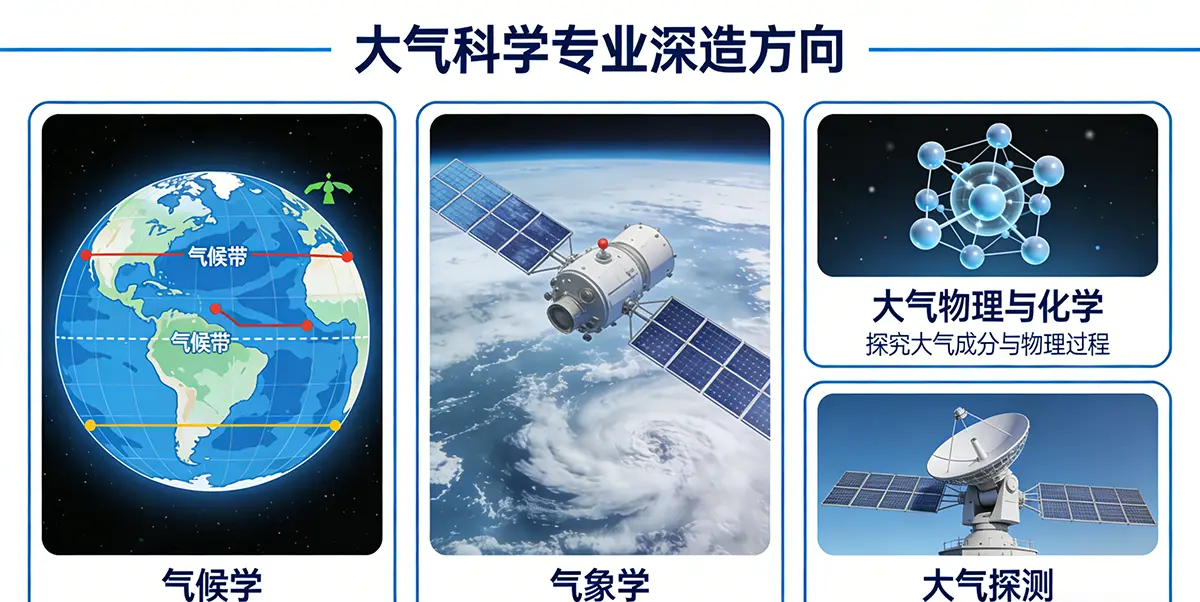
Pursuing advanced studies after undergraduate graduation is the predominant choice (with a postgraduate admission rate reaching 52.0%). Research directions are highly diverse and can be broadly categorized into the following major fields:
| Weather and Dynamics | Mesoscale Meteorology, Weather Dynamics, Numerical Forecasting and Modeling, Tropical Cyclones |
| Climate and Ecology | Monsoon and Climate Change, Climate System and Global Change, Paleoclimate, Agricultural Meteorology and Ecological Environment |
| Atmospheric Physics and Environment | Cloud and Precipitation Physics and Weather Modification, Atmospheric Physics and Atmospheric Detection, Atmospheric Chemistry and Aerosols, Satellite Remote Sensing and Radar Meteorology |
| Emerging Interdisciplinary Fields | Planetary Atmospheres, Aviation Meteorology, Marine Meteorology, Artificial Intelligence Applications in Meteorology |
Career Paths and Positions for Atmospheric Science Majors
Graduates of Atmospheric Science enjoy broad employment prospects with both stability and growth potential, achieving an initial employment rate of 89.1%.
| Career Paths | Positions |
| Meteorological Services (Primary Destination) | Weather Forecaster, Climate Forecaster, Meteorological Engineer, Public Weather Service Officer. |
| Civil Aviation/Military/Specialized Industries | Aviation Meteorologist, Meteorological Intelligence Officer, Marine Meteorologist. |
| Research & Educational Institutions | Researcher, Assistant Professor, Laboratory Engineer. |
| Emerging Technology/Environmental Protection/Energy Sector | Meteorological Algorithm Engineer, Data Analyst, New Energy (Wind/Solar) Resource Assessor, Environmental Consultant. |
Employment Rate and Industry Trends for Atmospheric Science Majors
- Employment Rate and Staffing: Meteorological departments are traditional public institutions. The national meteorological system annually provides a large number of public institution positions (e.g., the 2026 recruitment fair offered over 2,200 such positions), ensuring stable employment. Overall initial employment rates remain high, such as Shenyang Agricultural University's 89.1%.
- Industry Trends: Atmospheric science is undergoing profound transformation, driven by two core trends:
1. Deep Empowerment by “AI+”:
AI meteorological models like ‘Pangu’ and “Fengwu” are reshaping weather forecasting paradigms. Professionals skilled in AI algorithm development and meteorological knowledge integration will be highly sought after.
2. Multidisciplinary Convergence:
Meteorological technology is accelerating integration with low-altitude economy (drone logistics, urban air mobility), public health (climate change and health impacts), renewable energy (wind/solar power forecasting), and finance (weather derivatives), spawning numerous novel applications and job roles.

Ideal Candidates for Atmospheric Science Majors
If you possess the following traits, you may be well-suited for this field:
1. Curiosity about natural phenomena: You feel excited by spectacular clouds, thunderstorms, or rainbows and want to understand the underlying physical mechanisms.
2. Strong foundation in math and physics: You enjoy describing and solving problems using the language of mathematics and physics.
3. Comfort with computers: Open to programming and willing to process vast meteorological datasets or run numerical models using code.
4. Patience and accountability: Weather forecasting demands rigorous analysis and continuous monitoring, impacting public welfare and requiring strong responsibility.
5. Environmental and homeland commitment: A sense of mission toward grand issues like global climate change and environmental protection.
Core Competencies of Atmospheric Science Majors
The core strength of atmospheric science lies in its interdisciplinary capability to analyze complex, large-scale systems:
Physical intuition and mathematical modeling: Ability to abstract complex atmospheric movements into physical processes and mathematical equations (e.g., fluid dynamics and thermodynamic equations), forming the foundation for understanding and improving forecast models.
Data Analysis and Mining: Proficiency in processing and analyzing petabyte-scale meteorological big data from satellites, radars, and ground stations to extract actionable insights.
Numerical Model Application and Development: Expertise in operating numerical weather prediction (NWP) models and refining their parameterization schemes—the core technology of modern forecasting.
Interdisciplinary knowledge integration: Ability to combine meteorological knowledge with expertise in AI, computing, environmental science, energy, and other fields to solve specific industry application problems.
Leading Global Institutions
Atmospheric science is a globally significant discipline, with many top universities boasting strong atmospheric science departments or related research institutions. According to the 2025 Shanghai Ranking's Global Top Disciplines, the following institutions lead in this field:
| Country | Universities |
| United States | Global Top Representatives: University of Washington, Columbia University, Princeton University, University of Colorado Boulder, University of California Los Angeles |
| Other Strong Institutions: Massachusetts Institute of Technology, Harvard University, Stanford University, California Institute of Technology | |
| Mainland China | Top representatives: Nanjing University of Information Science and Technology, Nanjing University, Peking University, Tsinghua University, Sun Yat-sen University |
| Other strong institutions: Beijing Normal University, Fudan University, Lanzhou University, Zhejiang University, Ocean University of China, China University of Geosciences (Wuhan), Yunnan University | |
| United Kingdom/Europe | United Kingdom: University of Reading, University of Exeter, University of Oxford, University of Leeds, University of Cambridge |
| Switzerland: ETH Zurich | |
| France: Sorbonne University, Université Paris-Saclay | |
| Other Regions | Japan: The University of Tokyo, Hokkaido University, Kyoto University |
| Canada: University of Toronto, University of British Columbia | |
Australia: University of New South Wales, University of Tasmania |
Recommended Learning Path for Atmospheric Science Majors
1. Laying the Foundation (Freshman and Sophomore Years):
Focus on mathematical and physical fundamentals alongside programming. Master advanced mathematics, mathematical physics equations, and fluid mechanics—these form the bedrock for subsequent courses. Simultaneously, become proficient in Python from your freshman year and apply it to data processing and visualization, which will be crucial for future studies and research.
2. Build Your Professional Framework (Sophomore–Junior Years):
Delve into core theories like atmospheric physics, dynamic meteorology, and weather principles, balancing theoretical understanding with practical observation. Integrate theory with real-world weather processes through hands-on courses like weather map analysis and atmospheric observation experiments.
3. Focus and Deepening (Junior and Senior Years):
Elect advanced courses aligned with personal interests (e.g., theoretical research vs. operational applications; traditional meteorology vs. AI-driven meteorology), such as Numerical Weather Prediction, Satellite Meteorology, and Climate Dynamics. Aim to join a faculty research group and participate in specific projects (e.g., the “Undergraduate Innovation and Entrepreneurship Training Program”) to gain hands-on experience with the research process. Preparing for graduate school entrance exams is a common path and requires early planning.
4. Future Planning (Throughout):
| Research Path | Monitor summer programs at institutions like the Institute of Atmospheric Physics (Chinese Academy of Sciences), the Chinese Academy of Meteorological Sciences, and universities. Build a strong academic foundation and pursue publication opportunities. |
| Operational Path | Utilize winter/summer breaks to intern at local or target-city meteorological bureaus or civil airports to understand practical forecasting workflows. |
| Embrace Emerging Fields | Self-study machine learning and deep learning courses, participate in relevant competitions (e.g., meteorological technology contests), and experiment with AI models to solve meteorological problems—this is a valuable asset for entering tech companies. |
- The Previous Passage:Human Geography Major_Geography(Geog.)_人文地理
- The Next Passage:Chemistry(Chem.)_化学
Human Geography Major_Geography(Geog.)_人文地理
The Human Geography Major explores the complex relationships between human activities and space, cul···
-
Atmospheric Sciences(Atmos. Sci.)_大气科学
Atmospheric science is the study of phenomena and evolutionary patterns within Earth's atmospher···
Earth Sciences(Earth Sci.)_地球科学
The Earth Science major focuses on studying the Earth system and its interactions, providing a scien···
Ocean Sciences(Ocean Sci.)_海洋科学
PbootCMS是全新内核且永久开源免费的PHP企业网站开发建设管理系统,是一套高效、简洁、 强悍的可免费商用的···

