

Civil Engineering(Civ. Eng.)_土木工程
Time:2026-05-27 Visits:1
Civil Engineering Major
The Civil Engineering Major focuses on designing and constructing essential infrastructure. This overview details its core curriculum in structures and geotechnics, diverse career paths in design, construction, and management, and key trends like intelligent construction and sustainable development.
1. Introduction to the Civil Engineering Major
The Civil Engineering Major is a comprehensive scientific and technological system established to plan, design, construct, and maintain engineering facilities—such as buildings, bridges, roads, tunnels, dams, and municipal systems—that serve human production, daily life, and socioeconomic development. It focuses not only on technical implementation but also on optimizing the balance between safety, economy, environmental protection, and sustainability. As one of the oldest engineering disciplines, the Civil Engineering Major is often hailed as “the art of building the earth.”
2. Core Curriculum of the Civil Engineering Major
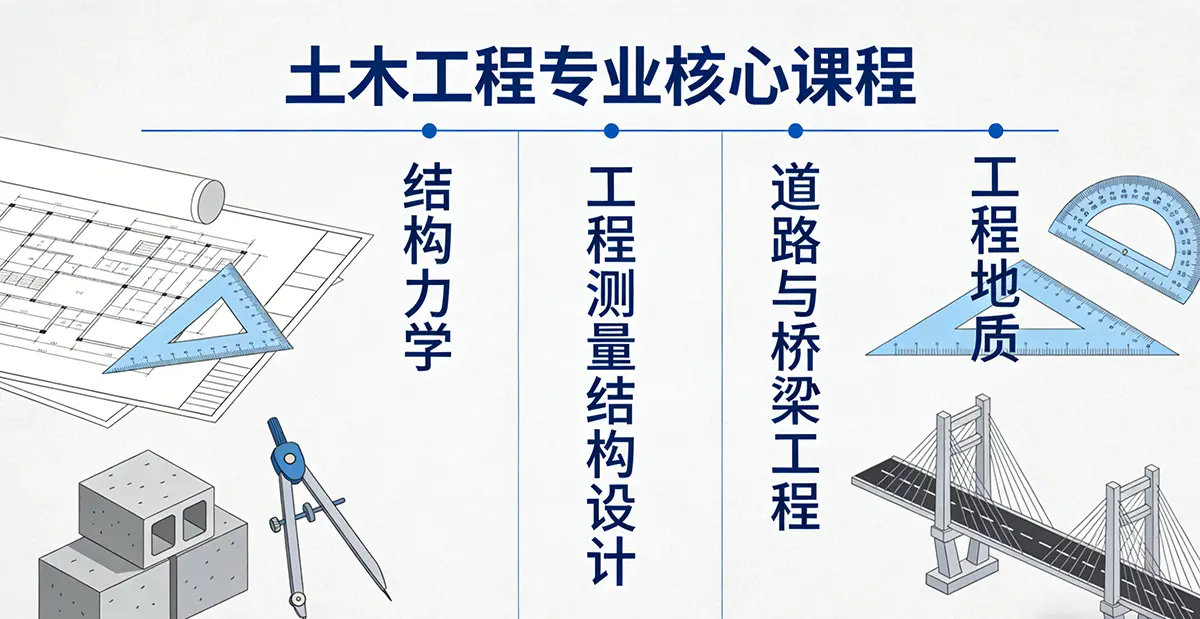
| Module Category | Core Courses |
| Foundational Sciences | Advanced Mathematics, Linear Algebra, Probability Theory and Mathematical Statistics, University Physics, Engineering Chemistry, Theoretical Mechanics |
| Professional Foundations | Mechanics of Materials, Structural Mechanics, Fluid Mechanics, Soil Mechanics, Engineering Geology, Engineering Materials (Concrete, Steel) |
| Core Design | Principles of Concrete Structure Design, Principles of Steel Structure Design, Foundation Engineering, Architectural Design, Civil Engineering Construction |
| Specialization Tracks | (Elective by track) Bridge Engineering, Highway Engineering, Tunneling and Underground Engineering, Seismic Design of Buildings, High-Rise Building Structures, Hydraulic Engineering, Engineering Cost and Management |
| Analysis, Computation, and Tools | Engineering Drawing and CAD, Fundamentals of Finite Element Analysis, Fundamentals of BIM Technology, Engineering Surveying, Civil Engineering Testing |
| Management and Regulations | Project Management, Construction Regulations, Engineering Economics |
3. Advanced Study Pathways for the Civil Engineering Major
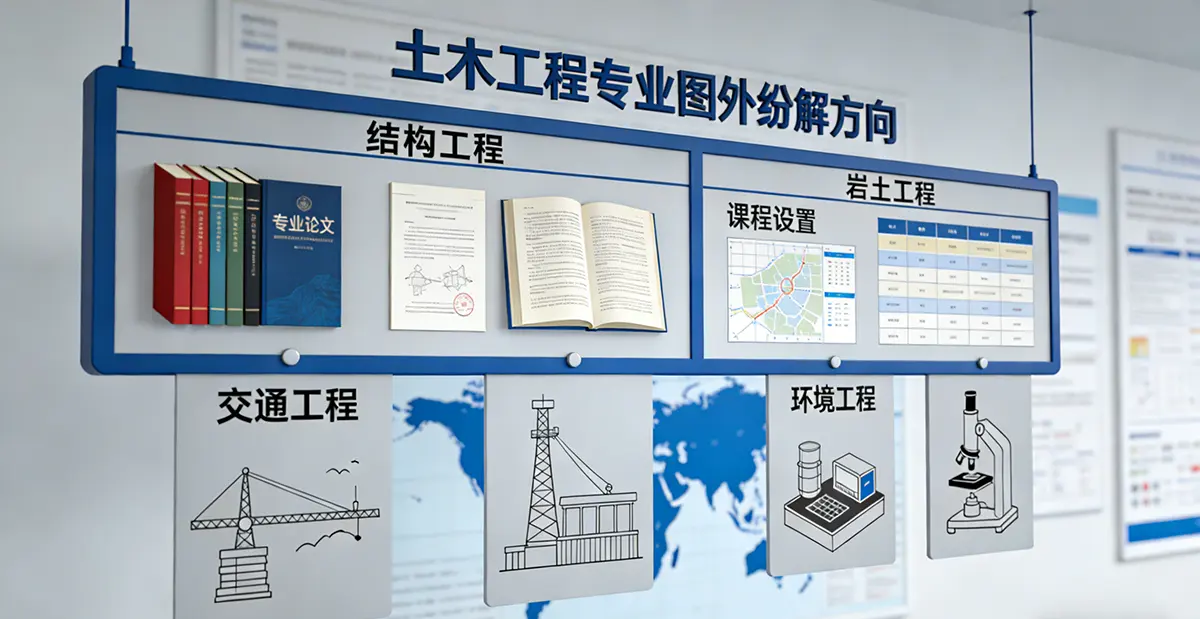
Master’s/PhD in Civil Engineering: Conduct in-depth research in specialized areas such as structural engineering, geotechnical engineering, bridge and tunnel engineering, and disaster prevention and mitigation.
Master’s in Architecture and Civil Engineering: Emphasize design or construction management.
Transportation Engineering / Water Resources Engineering: Specialize further in specific infrastructure domains.
Master of Engineering Management / Project Management: Transition to project planning, organization, and control.
Urban Planning / Municipal Engineering: Focus on urban development and infrastructure systems.
Materials Science and Engineering: Specialize in novel construction materials (e.g., high-performance concrete, smart materials).
Data Science / AI Applications: Apply to smart infrastructure and structural health monitoring.
4. Career Paths and Positions for Civil Engineering Graduates
| Sector | Specific Positions and Directions |
| Engineering Design/Research Institutes (Top Destination) | Structural Engineer (building/bridge design & analysis), Geotechnical Engineer (foundation, slope, tunnel stability analysis), Road/Bridge Designer |
| Construction Companies (Primary Sector) | Construction Supervisor/Technician (on-site management & organization), Project Manager (overall project leadership), BIM Engineer (Building Information Modeling creation & application) |
| Real Estate Development & Investment | Civil Engineer (project quality, schedule, and cost control), Development Application Specialist |
| Government Construction Management | Roles in Housing/Transportation Bureaus (construction approvals, quality & safety supervision, project management) |
| Engineering Consulting & Testing | Cost Estimator/Budgeter, Testing/Appraisal Engineer (structural safety assessment & reinforcement design) |
| Emerging & Cross-disciplinary Fields | Smart City O&M (infrastructure health monitoring & intelligent maintenance), Green Building (energy efficiency & low-carbon tech), Disaster Prevention & Mitigation (seismic/wind/flood engineering), Overseas Engineering (international projects e.g., Belt and Road) |
5. Employment Rates and Industry Trends for the Civil Engineering Major
Employment Rate Characteristics: “High Demand with Pronounced Cycles”: Closely tied to national fixed-asset investment and macroeconomic policies, leading to industry fluctuations. Long-term demand for new construction and maintenance/renovation persists. “Experience and Credentials are Crucial”: Career advancement is strongly linked to professional licensure (e.g., Registered Structural Engineer, Registered Geotechnical Engineer), and practical experience is highly valued. Diverse Work Settings: Design institute roles are typically office-based; construction firm positions often involve on-site project work with challenging conditions but offer rapid professional growth.
Industry Development Trends: Industrialized & Intelligent Construction: Prefabricated building, construction robotics, and advanced BIM applications are transforming traditional methods. Infrastructure Renewal & Resilience Enhancement: Massive demand exists for strengthening, rehabilitating, and upgrading aging infrastructure; resilient design for extreme weather is a priority. Green & Low-Carbon Transition: Development of sustainable materials, promotion of near-zero-energy buildings, and reduction of construction carbon emissions. Digitalization & Smart Operations: Digital twins, IoT, and AI are enabling full lifecycle management and safety monitoring of infrastructure, creating hybrid “Civil Engineering + IT” roles. Underground Space Development: Rapid expansion in urban subways, utility tunnels, and related projects.

6. Major Global Institutions Offering the Civil Engineering Major
| Country/Region | Representative Institutions (Leading in Civil Engineering) |
| United States | University of California, Berkeley; MIT; Stanford; University of Illinois at Urbana-Champaign; Georgia Tech |
| United Kingdom | University of Cambridge; Imperial College London; University of Oxford |
| Switzerland | ETH Zurich (Consistently top-ranked globally) |
| Netherlands | Delft University of Technology |
| Singapore | National University of Singapore; Nanyang Technological University |
| China | Tongji University; Tsinghua University; Southeast University; Harbin Institute of Technology; Zhejiang University |
| Other | University of Sydney (Australia); University of Tokyo (Japan) |
DisciplineMajor Recommendations
Ideal Candidates for the Civil Engineering Major
Individuals with a strong interest in large-scale construction projects, who enjoy seeing designs translated into reality. They should possess a solid foundation in mathematics and physics, strong spatial reasoning skills, and a meticulous, responsible attitude (as engineering safety is paramount). Adaptability to teamwork and potentially demanding on-site environments is essential, alongside important communication and coordination skills. A commitment to a career path that values long-term accumulation of experience is key.
Core Competitiveness of the Civil Engineering Major
Solid analytical and design capabilities in mechanics, particularly structural and soil mechanics. Proficiency in reading engineering drawings and applying CAD/BIM software. Practical problem-solving skills for complex on-site engineering challenges. Strong awareness of project management and economic cost considerations.
Study Recommendations for the Civil Engineering Major
Master the core mechanics courses: These form the foundational “internal strength” of civil engineering and determine professional potential. Prioritize course design projects, internships, and practical training: Actively engage in surveying practice, production placements, and design projects (e.g., for steel and concrete structures). Plan early for professional licensure: Understand the requirements for registered engineer exams and prepare accordingly. Master modern tools: Achieve proficiency in at least one BIM software (e.g., Revit) and learn programming languages like Python for data processing and automation. Develop communication and presentation skills: Effective interaction with diverse stakeholders—clients, designers, contractors—is crucial. Stay informed about industry frontiers and policies: Keep abreast of national initiatives like intelligent construction and green building.
Note: Some institutions may categorize this major under different academic disciplines. Please refer to the specific classification used by the institution.
- The Previous Passage:Communication Engineering(Commun. Eng.)_通信工程
- The Next Passage:New Media Technology(New Media Technol.)_新媒体技术
Human Geography Major_Geography(Geog.)_人文地理
The Human Geography Major explores the complex relationships between human activities and space, cul···

Atmospheric Sciences(Atmos. Sci.)_大气科学
Atmospheric science is the study of phenomena and evolutionary patterns within Earth's atmospher···

Earth Sciences(Earth Sci.)_地球科学
The Earth Science major focuses on studying the Earth system and its interactions, providing a scien···

Ocean Sciences(Ocean Sci.)_海洋科学
PbootCMS是全新内核且永久开源免费的PHP企业网站开发建设管理系统,是一套高效、简洁、 强悍的可免费商用的···

