

Communication Engineering(Commun. Eng.)_通信工程
Time:2026-05-25 Visits:2
Communication Engineering Major
Communication engineering Major serves as a bridge connecting the world, enabling real-time conversations between people separated by vast distances and facilitating the instantaneous transmission of massive data across global networks. As the cornerstone of the information technology revolution, communication engineering profoundly influences the development of modern society.
If telecommunications engineering were a tree, mathematics and physics would be its roots, signal processing and communication principles its trunk, wireless communication, optical communication, and network technology its lush branches, while 5G/6G, the Internet of Things, and artificial intelligence would be its abundant fruits.
Introduction to Communication Engineering Major: The Bridge Connecting the World
Communication engineering Major is a vital component of the electronic information field, primarily focusing on the transmission, exchange, and processing of information, as well as the design, development, and maintenance of communication systems and networks. Its core mission is to ensure information is delivered efficiently, securely, and accurately anytime, anywhere.
The major disciplines underpinning this field include Information and Communication Engineering, Electronic Science and Technology, and Computer Science and Technology, making it a quintessential interdisciplinary field. It addresses both underlying signal processing and hardware implementation, as well as higher-level network protocols and applications.
Its core missions include:
- Transmission: Studying how to efficiently transmit information such as voice, data, and images through channels (e.g., fiber optics, radio waves).
- Switching: Investigating how to route information between network nodes to ensure data reaches its destination accurately.
- Processing: Researching methods to encode, compress, enhance, and recognize signals to extract useful information.
- Networking: Investigating how to construct and manage complex communication networks to meet diverse user demands.
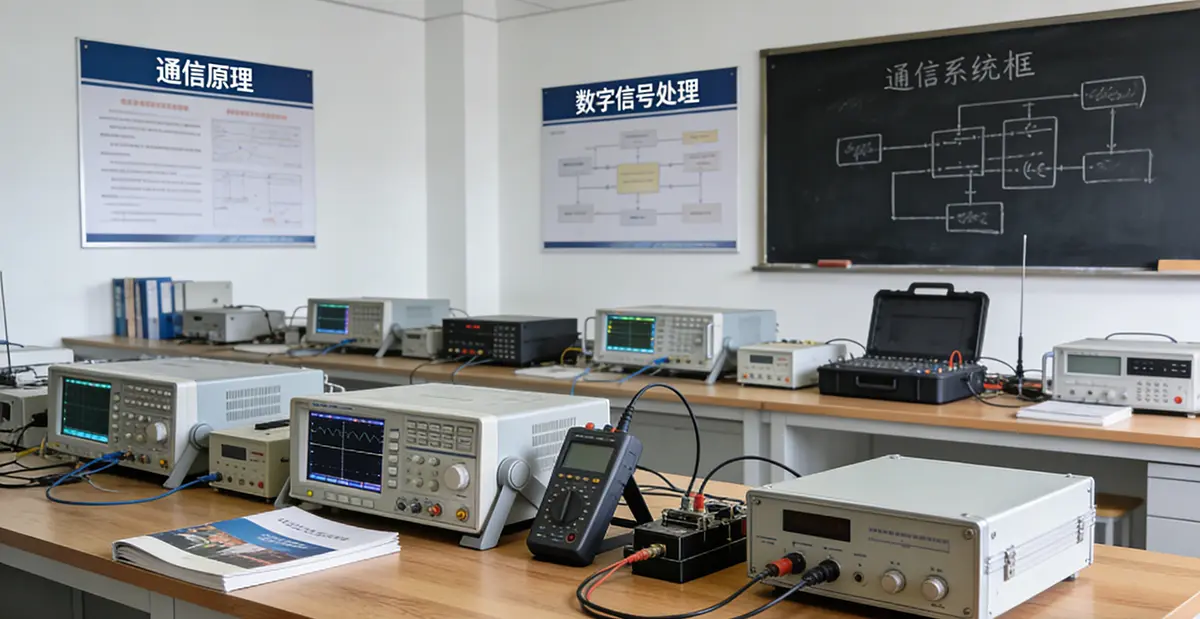
Core Courses at International Institutions
The curriculum emphasizes mathematical foundations and the integration of software and hardware. Students must master core theories like information theory and signal processing while developing engineering capabilities to design and implement communication systems.
| Course Phase | Core Course Examples | Learning Objectives |
| Mathematical Foundations | Advanced Mathematics, Linear Algebra, Probability Theory and Stochastic Processes, Engineering Mathematics (Complex Functions, Integral Transforms) | Establish a solid mathematical foundation for understanding and analyzing communication systems. |
| Circuits and Systems | Fundamentals of Circuit Analysis, Analog Electronics, Digital Electronics, Microcontroller Principles and Applications | Master the basic principles and methods of communication hardware design, enabling circuit design and debugging. |
| Signal Processing Core | Signals and Systems, Digital Signal Processing, Statistical Signal Processing | Study signal representation, transformation, and processing methods—essential tools for analyzing and designing communication systems. |
| Communication Theory Core | Communication Principles, Information Theory and Coding, Digital Communications, Mobile Communications | Deepen understanding of core communication system theories, including modulation/demodulation, encoding/decoding, and channel capacity. |
| Networks and Systems | Communication Networks, Network Protocols and Architecture, Mobile Communication Technology, Optical Communication Technology | Learn to build and manage communication networks, understanding the end-to-end communication process. |
| Practice and Tools | Embedded System Design, FPGA Development, MATLAB/Simulink Simulation, Communication System Course Design | Develop engineering capabilities in software/hardware development and system integration through practical projects. |
Advanced Study Directions in Communication Engineering Major
At the master's or doctoral level in Communication Engineering, research directions are closely aligned with industrial development and highly diversified:
- Wireless Mobile Communications: Focusing on future mobile communication systems (e.g., 6G), exploring cutting-edge technologies such as massive MIMO, millimeter-wave/terahertz communications, semantic communications, integrated communication-sensing systems, and drone communications.
- Intelligent Communication Networks: Investigating intelligent network architectures, novel network identifiers, routing algorithms, IoT, industrial internet, and vehicle-to-everything (V2X) communications.
- Intelligent Information Processing: Integrating artificial intelligence with signal processing to explore machine learning-based channel estimation and equalization, image/video/audio processing, multimodal information fusion, and quantum information processing.
- Integrated Air-Land-Sea-Space Networks: Research satellite communications, space information networks, and underwater optical communications to build a seamless global three-dimensional communication network.
- Communication Chip and System Design: Focus on the design, simulation, and verification of communication-specific chips (e.g., baseband chips, RF chips) and the hardware implementation of communication systems.
- Multimedia Communications: Research audio/video coding, compression, transmission, and reconstruction technologies, along with emerging multimedia applications like virtual reality (VR/AR) and haptic communications.

International Career Paths and Positions
Graduates in Communication Engineering Major are highly sought-after in the global job market, finding opportunities across virtually all fields related to information, networking, and intelligent systems.
| Industry Sector | Common Positions | Brief Job Responsibilities |
| Communications Equipment Manufacturers | Communications Algorithm Engineer, Embedded Software Engineer, Hardware Engineer, RF Engineer | Design and develop communication equipment such as base stations, routers, and switches at companies like Huawei, ZTE, Ericsson, and Nokia. |
| Telecom Operators | Network Planning & Optimization Engineer, Operations & Maintenance Engineer, Technical Support | At companies like China Mobile, China Unicom, China Telecom, AT&T, and Vodafone, responsible for planning, constructing, optimizing, and maintaining communication networks. |
| Internet and Technology Companies | Network Engineer, Cloud Computing Engineer, Data Communications Engineer, Multimedia Algorithm Engineer | At companies like Google, Microsoft, Alibaba, Tencent, and ByteDance, responsible for R&D and optimization of technologies including data center networks, CDN, and real-time audio/video transmission. |
| Semiconductor and Chip Design | Chip Design Engineer, FPGA Development Engineer, Verification Engineer | At companies like Intel, Qualcomm, AMD, and HiSilicon, participating in the design and development of communication chips. |
| Consumer Electronics and Automotive | Wireless Communications Engineer, In-Vehicle Communications Engineer, Antenna Engineer | At companies like Apple, Samsung, Huawei, and Tesla, responsible for designing wireless communication modules for products such as smartphones, tablets, and automobiles. |
| Aerospace and Defense | Satellite Communications Engineer, Navigation Engineer, Military Communications System Designer | Participate in R&D of communications and guidance technologies for satellites, radars, missiles, and other systems at national space agencies, defense research institutes, and related enterprises. |
| Research and Academia | Researcher, University Professor | Conduct cutting-edge communications technology research at universities or national research institutions. |
| Consulting and Investment | ICT Consultants, Technology Analysts | Provide strategic consulting to telecommunications enterprises or evaluate the investment value of communication technology projects for investment institutions. |
Global Employment Rates and Development Trends
Employment Rates: Communication Engineering maintains exceptionally high and stable employment rates worldwide. As global digital transformation accelerates, demand for communication professionals remains consistently strong.
- UK Communication Engineering graduates achieve approximately 90% employment rates, with graduates readily securing positions at internationally renowned multinational corporations offering competitive compensation packages.
- Domestic universities like Hefei University consistently maintain graduate employment rates above 95% for Communication Engineering programs.
- Master's graduates in Communication Engineering from Beijing University of Technology have achieved 100% employment for five consecutive years, with over 90% working in information and communications-related industries.
Industry Development Trends:
- Deep Integration of AI and Communications: Artificial intelligence is profoundly reshaping the design, construction, and operation models of communication networks. AI-empowered intelligent networks enable dynamic resource allocation and autonomous fault repair, while communication networks provide ubiquitous computing power connectivity for AI. This bidirectional empowerment represents a core trend for the next decade.
- 5G-Advanced and 6G Evolution: With the large-scale deployment of 5G-A technology and accelerated 6G standardization, future networks will achieve integrated coverage across air, land, sea, and space, supporting novel applications like holographic communication and digital twins.
- Intelligent Connectivity of All Things: Vertical industry applications like IoT, industrial internet, and vehicle-to-everything networks are booming, driving sustained demand for low-latency, high-reliability, and massive-connection communications—creating vast opportunities for communications engineers.
- Satellite Internet and Quantum Communications: Satellite internet has become a new global competitive frontier, while quantum communications demonstrate immense potential in information security, representing the future direction of communications technology.
Ideal Candidates and Core Competencies for Communication Engineering Major
If you possess the following traits, you may excel in communication engineering:
- Strong mathematical foundation: Communication theory fundamentally applies mathematics. You should not shy away from complex formulas in probability theory, stochastic processes, linear algebra, and signal processing.
- Versatility in both theory and practice: You're equally fascinated by abstract algorithms (like Fourier transforms and channel coding) and enjoy hands-on coding, debugging hardware boards, and witnessing data successfully transmitted through systems you designed.
- Systems thinking: You grasp the entire communication process from physical-layer bit streams to upper-layer application protocols, excelling at analyzing and solving problems from a holistic perspective.
- Sensitivity to Emerging Technologies: Curious about cutting-edge advancements like 5G/6G, Wi-Fi 7, and artificial intelligence, with a commitment to continuous learning to keep pace with rapid technological evolution.
Core Competency: Your core value lies in mastering information transmission systems—applying mathematics, signal processing, and networking theory to design, analyze, and optimize complex communication systems. This enables information to overcome temporal and spatial barriers, ensuring accurate, efficient, and secure delivery.

Major Institutions Offering Programs Worldwide
(Selected Institutions Listed - Rankings in Order)
1. China
The Chinese University of Hong Kong, Southeast University, University of Electronic Science and Technology of China, Tsinghua University, Xidian University, Beijing University of Posts and Telecommunications, Shanghai Jiao Tong University, Nanjing University of Posts and Telecommunications
2. United Kingdom
University of Southampton, University College London, Imperial College London, University of Surrey
3. Singapore
Nanyang Technological University, National University of Singapore
4. United States
Princeton University, Massachusetts Institute of Technology, Stanford University
5. Canada
University of Waterloo
6. Germany
University of Erlangen-Nuremberg
7. Australia
University of New South Wales
Recommended Learning Path for Communication Engineering Major
1. Undergraduate Stage: Build a solid foundation in mathematics and physics, cultivate engineering thinking
- Core: Master advanced mathematics, linear algebra, and probability theory—these form the bedrock for understanding communication theory. Simultaneously, thoroughly grasp core specialized courses like Signals and Systems, Principles of Communication, and Digital Signal Processing.
- Practical Application: Through course projects and labs, master simulation tools like MATLAB/Python. Attempt implementing a simple communication system (e.g., audio transmission) using FPGA or embedded platforms. Participate in electronics design competitions or mathematical modeling contests to hone hands-on skills and teamwork.
2. Master's Phase: Focus on Specialization, Enhance R&D Capabilities
- Objective: Select a specialization (e.g., wireless communications, networking, signal processing) aligned with your interests and career goals for in-depth study. Become proficient in one programming language (C/C++/Python) and one specialized tool (e.g., MATLAB, OPNET, NS3).
- Advancement: Join a research lab to participate in your advisor's projects and gain exposure to industry frontiers. Pursue internships at Huawei, ZTE, the three major telecom operators, or internet companies to gain practical engineering experience.
3. Doctoral & Postdoctoral Stages: Challenging Theoretical Frontiers, Leading Technological Innovation
- Positioning: If you crave exploring the unknown and aspire to become an expert in cutting-edge fields like 6G, quantum communication, or AI-integrated communications, doctoral studies are essential. Under your advisor's guidance, you will conduct in-depth research on a specific scientific or technical challenge.
- Future: PhD graduates are highly sought-after core talents by high-tech corporate research institutes (e.g., Huawei's 2012 Lab, Bell Labs), national research institutions, and top universities. They drive generational transformations in communication technology.
- The Previous Passage:Water Resources Engineering(Water Resour. Eng.)_水资源工程
- The Next Passage:Civil Engineering(Civ. Eng.)_土木工程

Human Geography Major_Geography(Geog.)_人文地理
The Human Geography Major explores the complex relationships between human activities and space, cul···

Atmospheric Sciences(Atmos. Sci.)_大气科学
Atmospheric science is the study of phenomena and evolutionary patterns within Earth's atmospher···

Earth Sciences(Earth Sci.)_地球科学
The Earth Science major focuses on studying the Earth system and its interactions, providing a scien···

Ocean Sciences(Ocean Sci.)_海洋科学
PbootCMS是全新内核且永久开源免费的PHP企业网站开发建设管理系统,是一套高效、简洁、 强悍的可免费商用的···

