

Clinical Psychology(Clin. Psychol.)_临床心理学
Time:2026-03-08 Visits:3
The Clinical Psychology Major is dedicated to the evidence-based assessment
and treatment of psychological disorders, as well as the promotion of individual
mental health. Adhering to the scientist-practitioner model, it cultivates
professionals with both solid research capabilities and proficient clinical
skills. Its rigorous doctoral curriculum and extensive clinical training
establish the foundational qualifications for students to enter hospitals,
private practice, academic research, and diverse mental health service fields.
Exploring the Clinical Psychology Major is the professional starting point for
becoming a core mental health service provider, addressing the growing societal
need for psychological support.

1. Introduction to the Clinical Psychology Major
Clinical Psychology is a core applied branch of the psychology discipline, focusing on the assessment, diagnosis, treatment, and prevention of psychological disorders, while simultaneously promoting individual mental health and personal growth. It is a highly specialized, evidence-based practice-oriented major that strictly adheres to the scientist-practitioner model, requiring practitioners to possess both solid psychological research abilities and proficient clinical intervention skills. Clinical psychologists are core professionals in the mental health field, typically requiring completion of a doctoral degree (PhD or PsyD) and a clinical internship, followed by passing licensure examinations, to practice independently.
2. Core Courses in the Clinical Psychology Major (Table)
*Note: This represents typical core courses for doctoral programs (PhD/PsyD). Undergraduate studies primarily consist of preparatory courses.*
| Module Category | Core Courses |
| Psychopathology and Assessment | Psychopathology (Advanced Abnormal Psychology), Principles of Psychological Assessment, Cognitive and Personality Assessment, Clinical Interview Techniques, Behavioral Observation Methods |
| Intervention Theory and Techniques | Psychotherapy Theories and Techniques (e.g., CBT, DBT, Psychodynamic, Humanistic), Group Therapy, Family and Couples Therapy, Crisis Intervention |
| Scientific Research Methods | Advanced Psychological Statistics, Research Design and Methods, Evidence-Based Practice, Advanced Psychometrics, Dissertation Seminar |
| Professional Ethics and Law | Ethical and Legal Issues in Clinical Psychology, Multicultural Counseling, Professional Development and Identity Formation |
| Physiological and Neurological Foundations | Fundamentals of Psychopharmacology, Health Psychology, Fundamentals of Neuropsychology |
| Professional Internship and Practice | Clinical Practicum, Pre-Doctoral Full-Time Internship (APA-Accredited Program), Supervised Clinical Practice (Typically Exceeding 3000 Hours) |
3. Advanced Study Pathways for the Clinical Psychology Major
Clinical Psychology itself represents the ultimate professional degree track. Further advancement primarily manifests in the following pathways:
Postdoctoral Research: Undertaking in-depth specialized training and research in specific areas such as childhood trauma, eating disorders, or neuropsychology.
Specialty Certification: Obtaining board certification in specialties like neuropsychology or rehabilitation psychology through bodies such as the American Board of Professional Psychology (ABPP).
Academic Research Path: After earning a PhD, pursuing a career in academia or research institutions, focusing on teaching and cutting-edge research in areas like psychological intervention mechanisms or digital therapeutics.

4. Career Paths and Positions for the Clinical Psychology Major
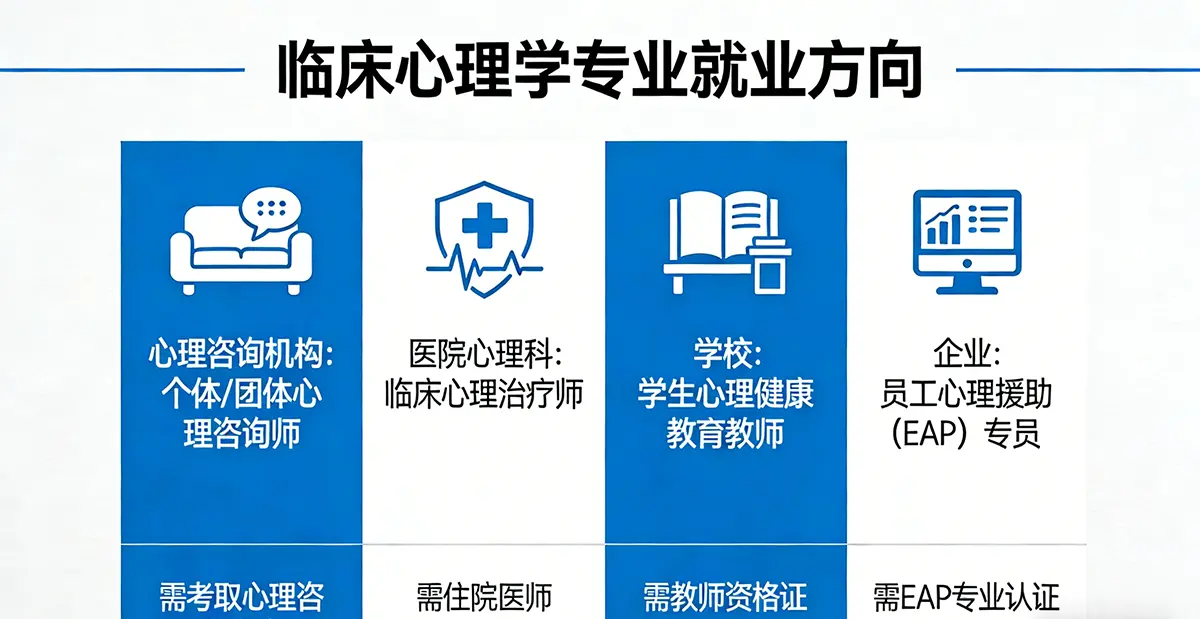
Employment is highly concentrated within mental health service systems, with a portion entering academia or applied research fields.
| Core Employment Sectors | Medical Institutions |
| Hospitals (Psychology Departments in General Hospitals / Psychiatric Specialty Hospitals): Licensed clinical psychologists responsible for psychological assessment, diagnosis, treatment, and interdisciplinary consultation. | Community Mental Health Centers: Providing psychological counseling and therapy services to the public. |
| Private Practice | Establishing individual or group private practices for counseling and psychotherapy. |
| Academic Institutions | Universities/Colleges: Serving as professors and clinical supervisors, potentially also providing services at university counseling centers. |
| Research Institutions | Government or private research institutes: Engaging in clinical trials, intervention effectiveness research, and mental health policy studies. |
| Judicial and Correctional Systems | Prisons, Courts: Conducting forensic assessments and providing psychological rehabilitation for offenders. |
| Corporations and Organizations | Employee Assistance Program (EAP) Providers: Delivering psychological services to corporate employees, typically as EAP consultants. |
5. Employment Rate and Industry Trends for the Clinical Psychology Major
Employment and Compensation Characteristics
“High Barriers to Entry, Long Training Cycle, High Demand”: The training cycle is exceptionally long (Bachelor's + 5-7 years Doctoral study + 1-2 years Internship). However, employment prospects are stable post-licensure, with particularly strong demand in areas experiencing shortages of mental health services.
Steady Salary Growth: Starting salaries vary significantly by region and specialty. Private practice and specialization (e.g., in neuropsychology) offer higher earning potential. Experienced clinical psychologists can command substantial incomes.
Licensure is Critical: Independent practice requires licensure; passing state/national licensing examinations is an essential mandatory step.
Industry Development Trends
Integrated Healthcare and Interdisciplinary Collaboration: Clinical psychologists are increasingly integrated into primary care, oncology, pain management, and other medical teams to provide behavioral health services.
Digitalization and Remote Mental Health Services: Telepsychology is becoming routine; the rise of digital therapeutics, such as app-based Cognitive Behavioral Therapy, offers adjunct or standalone treatment modalities.
Refinement and Personalization of Evidence-Based Practice: The focus shifts from “which treatment works” to personalized matching research on “for whom, under what conditions, and delivered by whom is it most effective.”
Emphasis on Prevention and Early Intervention: Increased focus on mental health promotion and early identification/intervention for high-risk populations (e.g., adolescents).
Cultural Competence as a Core Competency: Cultural sensitivity and corresponding intervention skills for clients from diverse racial, cultural, and LGBTQ+ backgrounds are becoming central training priorities.
6. Leading Global Institutions for the Clinical Psychology Major
Doctoral programs in Clinical Psychology are the standard training pathway for clinical psychologists globally, with admissions being highly competitive.(Partial University Display - Ranking in No Order)
Country/Region | Representative Institutions (Top Clinical Psychology Doctoral Programs)
United States | Harvard University, University of California, Los Angeles (UCLA), Yale University, University of Pennsylvania, University of Michigan, Ann Arbor (all offer APA-accredited top-tier Clinical Psychology PhD programs)
United Kingdom | University College London (UCL), University of Oxford, University of Cambridge, King's College London (Institute of Psychiatry, Psychology & Neuroscience)
Canada | University of Toronto, University of British Columbia (UBC), McGill University
Australia | University of New South Wales (UNSW), University of Sydney, University of Queensland
Other | University of Amsterdam (Netherlands), University of Auckland (New Zealand)
*Note: The training system for clinical psychology in Mainland China differs, typically offering clinical specializations within master's or doctoral programs in Basic or Applied Psychology, closely integrated with the medical system. Institutions like Peking University, Beijing Normal University, and East China Normal University hold significant influence in this field.*
7. DisciplineMajor Recommendations
Ideal Candidates for the Clinical Psychology Major
Individuals with a sustained internal drive and a strong sense of mission to help others overcome psychological distress and promote mental health.
Those who demonstrate exceptional empathy, emotional stability, self-awareness, and ethical consciousness.
Individuals possessing strong academic capabilities to simultaneously manage rigorous scientific research and demanding clinical training.
Those prepared to endure the long-term (8-10 years) educational commitment, financial pressure, and risk of emotional burnout.
Core Competencies of the Clinical Psychology Major
Deep understanding of mental disorder classification systems (e.g., DSM-5, ICD-11) and precise assessment and diagnostic skills.
Proficiency in selecting and implementing psychological interventions based on evidence.
The ability to establish and maintain effective therapeutic relationships.
Capacity for ongoing professional reflection and development within supervisory and ethical frameworks.
Study Recommendations for the Clinical Psychology Major
Build a strong research foundation during undergraduate studies: Actively participate in psychological research and strive for publications, as this is crucial for applications to top doctoral programs.
Accumulate relevant clinical experience: Volunteer at crisis hotlines, community centers, etc., to gain direct experience interacting with diverse populations.
Meticulously prepare for doctoral applications: Given the extremely low acceptance rates of doctoral programs, it is essential to contact potential advisors in advance and carefully prepare personal statements and research proposals.
Choose an APA/CPA-accredited doctoral program: This is critical for future internships, licensure applications, and employment.
Prioritize self-care throughout the training process: Seek personal therapy/experience, build a support system, and prevent professional burnout.
Stay informed about licensure requirements: Research the licensing examinations (e.g., EPPP) and required supervised clinical hours for your intended jurisdiction early on.
*Note: Some institutions may categorize this major under different disciplines. Please refer to the specific classification used by the institution.*
- The Previous Passage:History of Science(Hist. Sci.)_科学史
- The Next Passage:Anthropology(Anthrop.)_人类学

Human Geography Major_Geography(Geog.)_人文地理
The Human Geography Major explores the complex relationships between human activities and space, cul···

Atmospheric Sciences(Atmos. Sci.)_大气科学
Atmospheric science is the study of phenomena and evolutionary patterns within Earth's atmospher···

Earth Sciences(Earth Sci.)_地球科学
The Earth Science major focuses on studying the Earth system and its interactions, providing a scien···

Ocean Sciences(Ocean Sci.)_海洋科学
PbootCMS是全新内核且永久开源免费的PHP企业网站开发建设管理系统,是一套高效、简洁、 强悍的可免费商用的···

