

Law(Law)_法学
Time:2026-03-08 Visits:0
Law Major
The Law Major is dedicated to the systematic study of legal phenomena and institutions, cultivating students' legal reasoning and professional competencies. Its curriculum establishes a comprehensive knowledge system spanning from jurisprudential foundations to specialized legal fields, preparing students for careers in judiciary, law practice, corporate legal affairs, public service, and academic research. Exploring the Law Major is a crucial first step towards understanding societal norms, upholding justice, and participating in the construction of a modern legal system.

1. Introduction to the Law Major
Law is a social science discipline that examines legal phenomena, legal systems, and their operational principles. It aims to cultivate professionals who systematically master legal theory, are familiar with legal rules, and possess legal reasoning and professional competencies. Law is not merely a knowledge system of rules but also a profound inquiry into justice, rights, order, and power. As a foundational discipline in modern society, graduates of the Law Major serve as core contributors in fields such as legislation, judiciary, law enforcement, legal services, and corporate legal affairs.
2. Major Courses in the Law Major (Table)
| Module Category | Core Courses |
| Foundations of Legal Theory | Jurisprudence, History of Chinese Law, Constitutional Law, Comparative Law |
| Core Substantive Law | General Principles of Civil Law, Property Law, Law of Obligations (Contract Law, Tort Law), General Principles of Criminal Law, Specific Criminal Offenses, Administrative Law and Administrative Litigation Law |
| Procedural Law and Practice | Civil Procedure Law, Criminal Procedure Law, Evidence Law, Legal Clinic (Practical Course), Moot Court |
| Economic and Commercial Law | Commercial Law (Corporate Law, Securities Law, Negotiable Instruments Law), Economic Law, Intellectual Property Law, Labor and Social Security Law |
| International Law and Frontiers | Public International Law, Private International Law, International Economic Law, Internet and Data Law, Artificial Intelligence and Law |
| Legal Methods and Skills | Legal Logic, Legal Research, Legal Writing, Legal English |
3. Advanced Study Pathways for the Law Major
Master of Laws (LL.M.)/Juris Master (J.M.): Advanced specialized studies, typically with concentrations (e.g., Civil and Commercial Law, Criminal Law, International Law).
Doctor of Juridical Science (J.S.D.)/Ph.D. in Law: For careers in legal academic research and university faculty positions.
Professional Qualification: Passing the National Legal Professional Qualification Examination is a prerequisite for most legal practice roles.
Interdisciplinary Master's Programs: Such as Law and Finance, Law and Public Policy, Law and Technology.
Overseas LL.M. (Master of Laws): Studying abroad to gain international legal perspectives and credentials.

4. Career Paths and Positions for Law Majors
Career paths for Law Majors are characterized by "professional qualification orientation" and "industry diversity," with passing the bar exam being a critical milestone.
Traditional Legal Professions (Require Passing the Bar Exam)
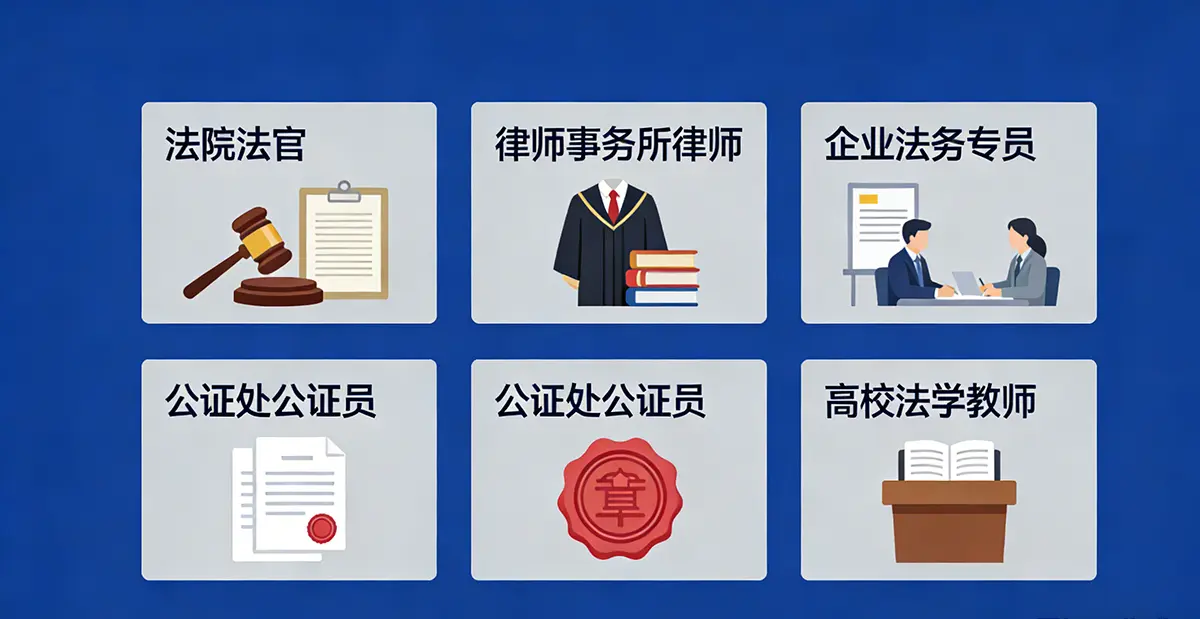
Judicial Authorities: Judges, Prosecutors (selected via civil service exams and a quota-based appointment system).
Lawyers: Practicing attorneys in law firms, specializing in litigation or transactional/non-contentious work.
Government Legal Departments: Civil service positions in legislative bodies and administrative legal offices.
Public Administration and Service
Civil Service System: Numerous roles (e.g., in market regulation, taxation, customs, discipline inspection) value a legal background.
Notary Public Offices, Arbitration Institutions: Notaries, Arbitration Secretaries.
Corporate Legal Affairs and Compliance
Corporate Legal Departments: Legal Specialists/Managers responsible for contract review, compliance management, and dispute resolution.
Financial Institutions: Risk control and compliance roles in banks, securities firms, and funds.
Technology Companies: Data Privacy Officers, Intellectual Property Managers.
Emerging and Cross-disciplinary Fields
Intellectual Property Agencies: Patent Agents, Trademark Agents.
Legal Technology Companies: Roles in product development, operations, legal data analysis.
International Organizations and NGOs: Legal Advisors, Program Officers.
Legal Education and Research: University Faculty, Researchers (typically requiring a doctoral degree).
5. Employment Rates and Industry Trends for the Law Major
Employment Rate Characteristics
"Hard work precedes success, qualification is king": Initially, passing the challenging bar exam is required, after which career paths significantly broaden. Those who do not pass face limited options.
"Pronounced Pareto principle (80/20 rule)": Income disparity in the legal profession is vast. Top-tier law firms ("red circle," "magic circle") offer extremely high compensation amid fierce competition; the mass legal services market is large but offers modest income.
"Stability and challenge coexist": Civil service and in-house counsel roles offer stability; lawyer and compliance roles present both challenges and opportunities.
Rising educational requirements: Core legal positions in first-tier cities commonly require a master's degree.
Industry Development Trends
Deepening Specialization and Segmentation: Strong demand in legal markets for highly specialized lawyers in areas like capital markets, cross-border investment, antitrust, bankruptcy restructuring, intellectual property, and data compliance.
Technology Profoundly Reshaping the Legal Industry: Legal Tech (AI-powered contract review, legal research, online dispute resolution platforms); Emerging Legal Issues (copyright for AI-generated content, liability for autonomous vehicles, regulation of digital currencies).
Corporate Compliance as a Strategic Core: Explosive growth in demand for corporate compliance systems, ESG compliance, and export controls amid stringent regulatory environments (e.g., Data Security Law, Anti-Foreign Sanctions Law).
Internationalization and Cross-border Legal Services: The Belt and Road Initiative and globalization of Chinese enterprises have created massive demand for cross-border lawyers proficient in international rules and foreign languages.
Diversification of Dispute Resolution Methods: Increasing prevalence of alternative dispute resolution mechanisms like arbitration and mediation.
6. Leading Global Institutions for the Law Major
Law is a traditional core discipline in higher education with a long-standing global tradition of law schools.(Selected Schools - Listed in no particular order)
Country/Region | Representative Institutions (Top Law Schools)
United States | Yale Law School, Harvard Law School, Stanford Law School, University of Chicago Law School
United Kingdom | University of Oxford, University of Cambridge, London School of Economics and Political Science (LSE)
Germany | Heidelberg University, Ludwig Maximilian University of Munich
France | Panthéon-Sorbonne University (Paris 1)
China | Peking University, Tsinghua University, Renmin University of China, China University of Political Science and Law, Wuhan University
Other | National University of Singapore, The University of Tokyo, University of Melbourne
7. DisciplineMajor Recommendations
Ideal Candidates for the Law Major
Possess a strong sense of justice, logical reasoning skills, and an interest in societal rules and norms.
Have excellent memory, written expression skills, and resilience under pressure.
Are meticulous, detail-oriented, patient, and capable of handling complex legal provisions and case details.
Excel in communication, negotiation, and persuasion.
Core Competencies of the Law Major
A solid knowledge system of specialized legal fields and the ability to interpret and apply law.
Acute legal logic and case analysis skills.
Outstanding legal writing and oral advocacy abilities.
A capacity for lifelong learning to adapt to constant legal revisions and emerging fields.
Study Recommendations for the Law Major
Make passing the bar exam a core objective: Plan your study schedule effectively and start preparation early.
Build a strong legal foundation: Pay particular attention to the three major substantive law areas—Civil, Criminal, Administrative—and procedural law.
Engage in legal practice: Accumulate practical experience through internships, legal aid, and moot court competitions.
Master legal research and writing: These are fundamental skills for legal professionals.
Develop foreign language proficiency: English is essential; mastering a second language (e.g., German, Japanese) offers significant advantages in specific fields.
Clarify your career direction early: Are you inclined toward litigation or transactional work? Aiming for a law firm, corporate role, or public service? Develop targeted skills accordingly.
Note: Some institutions may categorize this program under different disciplines. Please refer to the specific classification used by the target institution.
- The Previous Passage:Financial Management(Fin Mgmt)_财务管理
- The Next Passage:Real Estate(RE)_房地产

Human Geography Major_Geography(Geog.)_人文地理
The Human Geography Major explores the complex relationships between human activities and space, cul···

Atmospheric Sciences(Atmos. Sci.)_大气科学
Atmospheric science is the study of phenomena and evolutionary patterns within Earth's atmospher···

Earth Sciences(Earth Sci.)_地球科学
The Earth Science major focuses on studying the Earth system and its interactions, providing a scien···

Ocean Sciences(Ocean Sci.)_海洋科学
PbootCMS是全新内核且永久开源免费的PHP企业网站开发建设管理系统,是一套高效、简洁、 强悍的可免费商用的···

