

Philosophy(Philos.)_哲学
Time:2026-04-27 Visits:2
Philosophy Major
The Philosophy Major cultivates critical thinking, logical analysis, and ethical reasoning through the study of fundamental questions. This guide details its core curriculum in metaphysics, ethics, and logic, explores graduate pathways and diverse career options in law, tech, and public policy. Discover how the Philosophy Major provides a versatile framework for addressing complex challenges in a rapidly changing world.
1. Introduction to the Philosophy Major
The Philosophy Major is an ancient discipline dedicated to exploring fundamental questions concerning existence, knowledge, value, reason, and mind. Rather than providing specific technical answers, the Philosophy Major cultivates critical thinking, rigorous logical analysis, and precise conceptual clarity. It trains students to systematically examine the basic questions of the world and human life, scrutinize the premises and arguments underlying various beliefs, and develop the capacity to construct and evaluate complex arguments. In contemporary society, the Philosophy Major provides an indispensable framework for grappling with complex challenges such as technological ethics, social justice, and political discord.
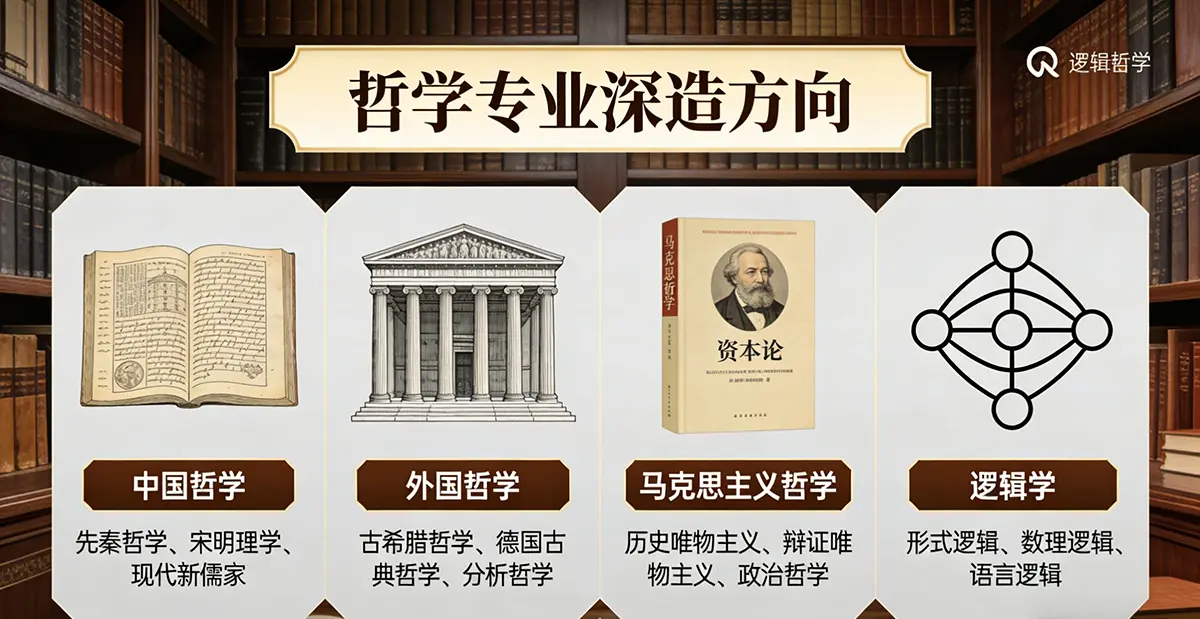
2. Core Curriculum for the Philosophy Major
| Module Category | Core Courses |
| Core Subfields | Metaphysics, Epistemology, Ethics, Logic, Philosophy of Mind |
| History & Classics | History of Chinese Philosophy, History of Western Philosophy, Marxist Philosophy, Close Reading of Classic Texts |
| Applied & Practical Philosophy | Political Philosophy, Technology Ethics, Business Ethics, Environmental Ethics, Medical Ethics, Philosophy of Law |
| Interdisciplinary & Special Topics | Philosophy of Science, Philosophy of Language, Philosophy of Art (Aesthetics), Philosophy of Religion, Feminist Philosophy, Comparative Philosophy |
| Methods & Skills | Formal Logic, Argument Analysis & Writing, Philosophical Research Methodology, Academic Writing & Criticism |
3. Advanced Study Pathways for the Philosophy Major
MA/PhD in Philosophy: Pursue an academic career as a professional researcher and university professor.
Interdisciplinary Graduate Studies: Combine with Law (JD), Public Policy (MPP/MPA), Journalism, or Theology to apply philosophical reasoning to concrete fields.
Master of Applied Ethics: Specialize in tech ethics, bioethics, or environmental ethics for roles on ethics review boards or in corporate ethics departments.
Cognitive Science/Philosophy of Mind: Enter interdisciplinary research at the intersection of psychology, neuroscience, or artificial intelligence.
Analytic Philosophy & Logic: Advance into specialized areas like formal logic, philosophy of mathematics, or philosophy of language.

4. Career Pathways for the Philosophy Major
| Core Employment Sectors | Typical Positions | Primary Responsibilities & Skill Application |
| Education & Academia | University Professor/Researcher, High School Teacher | Teaching, academic research, instructing critical thinking and ethics. |
| Consulting & Professional Services | Management Consultant, Risk & Compliance Advisor | Solving business problems via logical analysis, assessing compliance/ethical risks. |
| Technology & Emerging Industries | Tech Ethics Officer/Product Ethics Consultant, Tech Policy Analyst | Evaluating ethical implications, setting guidelines, researching societal impacts of technology. |
| Legal & Public Sectors | Lawyer/Paralegal, Civil Servant/Policy Analyst, Nonprofit Program Officer | Legal reasoning/document drafting, policy research/development, human rights/social justice project management. |
| Media & Publishing | Journalist/Editor/Commentator, Content Strategist | In-depth reporting/commentary, developing insightful brand narratives and content. |
| Business & Management | HR/Corporate Culture Specialist, Business Analyst | Designing corporate values/ethics training, analyzing business data and processes logically. |
5. Employment & Industry Trends for the Philosophy Major
Employment Characteristics
Broad, non-linear pathways: Success hinges on translating abstract competencies into industry-specific skills and experience.
Long-term value with strategic entry: Analytical and leadership skills yield strong career trajectories, though initial entry may require supplementary training or experience.
High dependence on personal initiative: Proactive networking and skill demonstration are crucial.
Industry Trends
Explosive demand in technology ethics, especially for AI and biotech.
Growing need for complex decision-support skills in an era of information overload.
Increasing value of interdisciplinary “humanities + technology” profiles.
Rise of lifelong learning and critical thinking education in corporate and general contexts.

6. Leading Global Institutions for the Philosophy Major
(Selected Institutions - No particular ranking)
| Country/Region | Representative Institutions (Leading or Distinctive Programs) |
| Anglo-American Analytic | University of Oxford, University of Cambridge, New York University, Princeton University, University of Pittsburgh, Rutgers University |
| Continental Tradition | Université Paris 1 Panthéon-Sorbonne, Heidelberg University, Goethe University Frankfurt, KU Leuven (Belgium) |
| Other Anglophone | University of Toronto (Canada), Australian National University, University of St Andrews (Scotland) |
| Asia | The University of Tokyo, National University of Singapore, The Chinese University of Hong Kong, National Taiwan University |
| China | Peking University, Fudan University, Renmin University of China, Wuhan University, Sun Yat-sen University |
DisciplineMajor Recommendations
Ideal Candidates for the Philosophy Major
Driven by fundamental curiosity about the world, enjoy asking “why,” and seek deeper answers.
Find intellectual satisfaction in reading, contemplation, debate, and rigorous argumentation.
Possess an open, reflective mindset and willingness to challenge assumptions.
Have strong communication skills or dedication to developing them.
Core Competencies of the Major
Advanced critical thinking to identify presuppositions, fallacies, and construct sound arguments.
Ability to analyze complex concepts and grasp the essence of problems.
Clarity in written and oral argumentation for articulating intricate ideas.
Systematic ethical reasoning and value discernment in moral dilemmas.
Study Recommendations
Read classics deeply and write extensively to hone philosophical thinking.
Master formal logic as the essential foundational tool.
Proactively develop a “second specialty” by combining philosophy with a practical field.
Engage actively in seminars and workshops to refine ideas through discussion.
Plan your career path early; translate philosophical skills into industry-valued competencies through internships and networking.
*Note: Program classification varies by institution.*
- The Previous Passage:English Language and Literature(English Lang. & Lit.)_英语语言文学
- The Next Passage:没有了!

Human Geography Major_Geography(Geog.)_人文地理
The Human Geography Major explores the complex relationships between human activities and space, cul···

Atmospheric Sciences(Atmos. Sci.)_大气科学
Atmospheric science is the study of phenomena and evolutionary patterns within Earth's atmospher···

Earth Sciences(Earth Sci.)_地球科学
The Earth Science major focuses on studying the Earth system and its interactions, providing a scien···

Ocean Sciences(Ocean Sci.)_海洋科学
PbootCMS是全新内核且永久开源免费的PHP企业网站开发建设管理系统,是一套高效、简洁、 强悍的可免费商用的···

