

Acoustics(Acoust.)_声学
Time:2026-05-15 Visits:2
Acoustics (Engineering Acoustics) Major
The Acoustics (Engineering Acoustics) Major focuses on the generation, propagation, control, and application technologies of sound waves, dedicated to solving practical problems in noise control, audio engineering, and ultrasonic testing. This discipline serves as a bridge between fundamental physics and engineering applications, playing a key technological role in fields such as environmental protection, high-end manufacturing, consumer electronics, and healthcare.
1. Introduction to the Acoustics (Engineering Acoustics) Major
The Acoustics (Engineering Acoustics) Major is a vital branch of physics, specializing in the engineering application of sound wave generation, propagation, reception, effects, and control technologies. It employs principles and techniques from physics, mathematics, electronics, and signal processing to solve practical problems in areas such as noise and vibration control, electroacoustic transduction, architectural acoustics, ultrasonic applications, and audio engineering. This Major finds extensive application in environmental protection, communications, healthcare, consumer electronics, and national defense, serving as a pivotal technology for achieving “quiet environments” and “high-quality sound.”
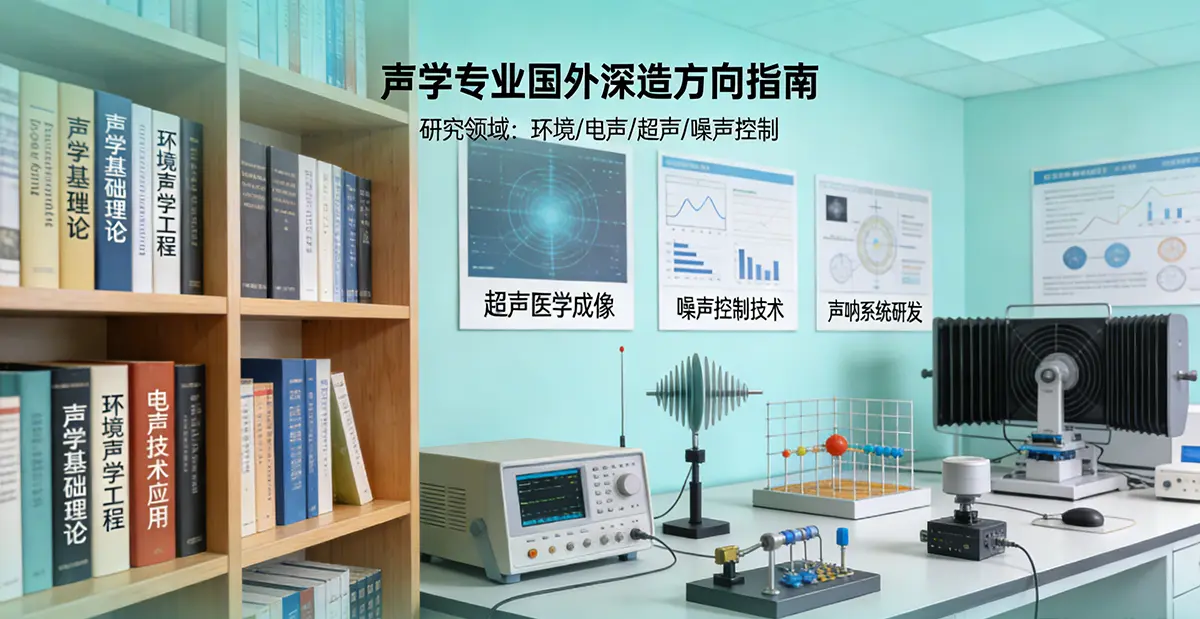
2. Major Courses in the Acoustics (Engineering Acoustics) Major
| Module Category | Core Courses |
| Mathematics and Physics Foundations | Advanced Mathematics, Mathematical Methods in Physics, Complex Variables, University Physics (Mechanics, Vibration and Waves), Theoretical Mechanics |
| Core Acoustic Theory | Fundamentals of Acoustics, Vibration Theory, Principles of Noise Control, Electroacoustics, Architectural Acoustics, Fundamentals of Ultrasonics |
| Signals and Systems | Signals and Systems, Digital Signal Processing, Random Signal Analysis, Acoustic Measurement Techniques |
| Engineering Application Technology | Noise and Vibration Control Engineering, Loudspeaker and Microphone Design, Audio System Design, Acoustic Materials and Structures |
| Computational and Simulation Methods | Numerical Methods in Acoustics (Finite Element/Boundary Element), Acoustic Simulation Software Applications (e.g., COMSOL, LMS Virtual.Lab), Scientific Programming (MATLAB/Python) |
| Experiments and Measurements | Acoustic Experiments, Sensors and Measurement Instruments, National Standards and Regulations (e.g., Environmental Noise Quality Standards) |
3. Advanced Study Pathways for the Acoustics (Engineering Acoustics) Major
Master's/PhD in Acoustics/Vibration Engineering: Conduct in-depth research into cutting-edge fields such as physical acoustics, structural acoustics, computational acoustics, and psychoacoustics.
Master's in Environmental Science and Engineering: Focus on environmental noise assessment and mitigation.
Master's in Mechanical Engineering (NVH Track): Engage in research on Noise, Vibration, and Harshness (NVH) in automotive, aerospace, and related sectors.
Master's in Biomedical Engineering: Research areas including medical ultrasound and hearing rehabilitation.
Master's in Communications and Information Systems: Focus on speech signal processing and audio coding/decoding.
Master's in Architectural Technology Science: Specialize in indoor acoustic design and auditorium acoustics.

4. Career Paths and Positions for the Acoustics (Engineering Acoustics) Major
This Major has strong practical applicability, ensuring stable demand within high-end manufacturing, environmental protection, consumer electronics, and research sectors.
Core Employment Sectors
High-End Manufacturing NVH (Noise, Vibration, and Harshness):
Automotive Industry: NVH Engineer at vehicle manufacturers (e.g., Volkswagen, Toyota, Geely) or component suppliers, responsible for vehicle noise and vibration testing, analysis, and optimization.
Aerospace: Aircraft cabin acoustic design engineers, engine noise control engineers.
Home Appliance Industry: Noise reduction engineers for products such as refrigerators, air conditioners, and washing machines.
Environmental Noise Control:
Environmental Protection Companies/Design Institutes: Noise Control Engineer, responsible for noise prediction, assessment, and mitigation plan design for projects like highways, railways, and factories.
Government Agencies: Noise monitoring and management personnel at environmental monitoring stations.
Electroacoustics and Audio Industry:
Consumer Electronics Companies (e.g., Huawei, Xiaomi, Apple, Sony): Electroacoustic Engineer, responsible for speaker and microphone design and audio tuning in products like smartphones, headphones, and speakers.
Professional Audio Companies (e.g., Sennheiser, BOSE): Audio Product R&D Engineer.
Architectural Acoustics and Sound Quality Design:
Architectural Design Institutes/Acoustic Consulting Firms: Architectural Acoustics Designer, responsible for the acoustic design and consultation of concert halls, theaters, conference rooms, and recording studios.
Ultrasonics and Inspection:
Medical Device Companies: Medical Ultrasound Probe R&D Engineer.
Industrial Inspection: Non-Destructive Testing Engineer.
Research Institutes and Universities:
Institute of Acoustics, Chinese Academy of Sciences; university departments related to acoustics: Researcher, Faculty Member (typically requires a PhD).
5. Employment Rate and Industry Trends for the Acoustics (Engineering Acoustics) Major
Employment Rate Characteristics
“Niche, Specialized, with Stable Demand”: The field has a small scale but features high technical barriers in its specialized segments. Limited talent supply results in relatively moderate employment competition and good stability.
“High Value of Experience”: Acoustic problem-solving often requires an integrated approach combining theory, simulation, and practical measurement experience, making experienced senior engineers particularly scarce.
Upper-Mid-Level Compensation: Salaries for core R&D positions in industries such as automotive and consumer electronics are competitive.
Industry Development Trends
New NVH Challenges in Electrified and Smart Connected Vehicles: Electric vehicles eliminate engine noise, amplifying tire noise, wind noise, and high-frequency sounds from electric drive systems. Simultaneously, active acoustic design (e.g., pedestrian warning sounds, in-cabin active noise cancellation, and audio systems) has emerged as a new focal point.
Audio Experience Enhancement in Smart Home and Wearable Devices: Products like true wireless earbuds and smart speakers continually drive electroacoustic innovation through demands for spatial audio, adaptive noise cancellation, and miniaturized, high-performance speakers.
AI-Based Acoustic Signal Processing and Intelligent Monitoring: Artificial intelligence is being applied to acoustic fault diagnosis (industrial equipment), soundscape recognition and analysis (smart environmental protection), and intelligent speech enhancement and separation.
Digital Twins and Virtual Acoustics: In virtual reality (VR) and automotive R&D, constructing acoustic digital twin models enables high-fidelity virtual sound simulation and auralization.
Precision Control and Comfort Enhancement of Environmental Noise: Technologies include dynamic monitoring of urban noise maps, low-noise pavement and rail solutions, and innovative sound insulation/absorption structures based on acoustic metamaterials.
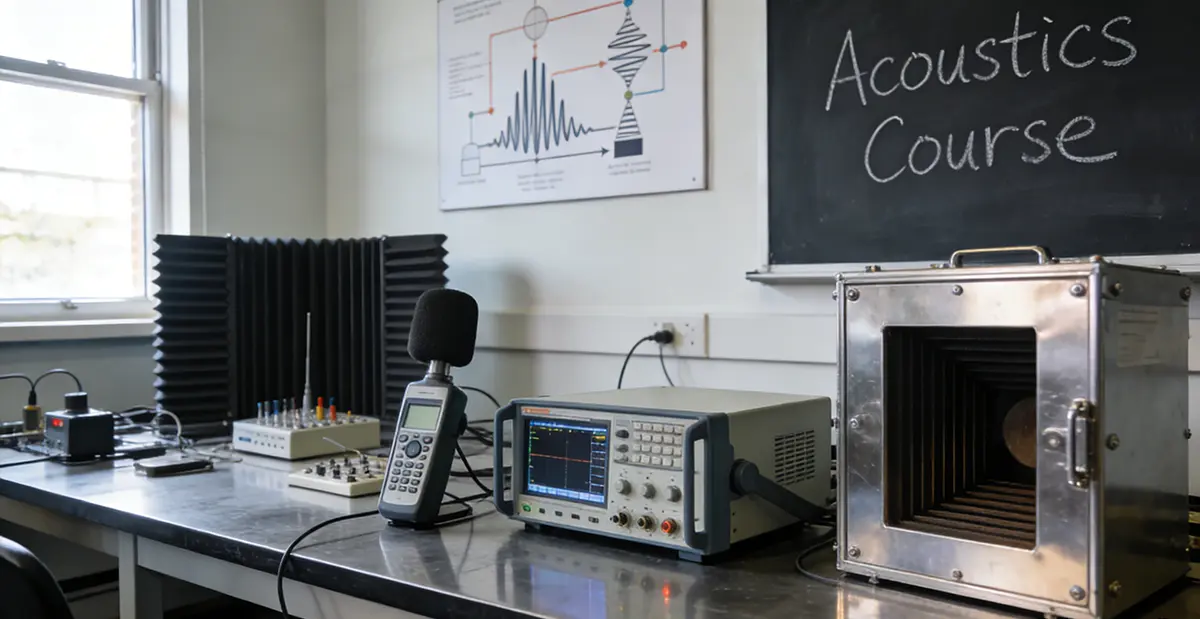
6. Major Global Institutions Offering the Acoustics (Engineering Acoustics) Major
Acoustics programs are typically housed within physics departments, engineering schools, or independent research institutes.
| Country/Region | Representative Institutions (Leading Institutions in Acoustics) |
| United States | Pennsylvania State University (Graduate Program in Acoustics), Massachusetts Institute of Technology, University of California, Los Angeles |
| Germany | Technical University of Berlin, Karlsruhe Institute of Technology (Strong in Acoustic Technology) |
| Denmark | Technical University of Denmark (Leading in Electroacoustics and Audio Signal Processing) |
| United Kingdom | University of Southampton (World-renowned Institute of Sound and Vibration Research - ISVR), University of Salford |
| China | Nanjing University (Institute of Acoustics), Tongji University (Institute of Acoustics), Harbin Engineering University (Specializes in Underwater Acoustics Engineering), Northwestern Polytechnical University |
| Other | KU Leuven (Belgium), University of Sydney (Australia) |
DisciplineMajor Recommendations
Ideal Candidates for the Acoustics (Engineering Acoustics) Major:
Individuals with a keen perception of and curiosity about sound and vibration phenomena, who enjoy exploring the underlying physical principles.
Those with a solid foundation in mathematics and physics, coupled with good hands-on experimental skills.
Individuals who enjoy solving complex, practical engineering problems and can integrate theory, simulation, and testing.
Candidates who are patient and detail-oriented, as acoustic measurement and debugging often require iterative processes.
Core Competencies of the Acoustics (Engineering Acoustics) Discipline:
A solid theoretical foundation in acoustics and clear physical concepts.
Proficiency in acoustic measurement, analysis, and simulation.
Interdisciplinary application skills (able to integrate acoustics knowledge with mechanical, electronic, architectural, psychological, and other fields).
Engineering experience in solving practical noise or sound quality problems.
Study Recommendations for the Acoustics (Engineering Acoustics) Major:
Strengthen mathematical and scientific fundamentals: particularly vibration theory, wave equations, and signal processing.
Achieve proficiency with acoustic measurement equipment and common simulation software: such as test systems from B&K or NI, and at least one mainstream acoustic simulation software.
Actively participate in practical projects or internships: seek opportunities in automotive NVH departments, electroacoustic companies, or acoustic consulting firms.
Cultivate listening skills: establish correlations between subjective assessments of sound quality and noise characteristics and their corresponding objective parameters.
Stay informed about target industry standards and regulations (e.g., automotive NVH standards, building acoustics codes, environmental noise limits).
Learn programming and data analysis: to process large volumes of acoustic test data or develop specialized algorithms.
Note: Some institutions may categorize this Major under different disciplines. Please refer to the specific classification used by your chosen institution.
- The Previous Passage:Biomedical Engineering(Biomed. Eng.)_生物医学工程
- The Next Passage:Food Science and Engineering(Food Sci. Eng.)_食品科学与工程

Human Geography Major_Geography(Geog.)_人文地理
The Human Geography Major explores the complex relationships between human activities and space, cul···

Atmospheric Sciences(Atmos. Sci.)_大气科学
Atmospheric science is the study of phenomena and evolutionary patterns within Earth's atmospher···

Earth Sciences(Earth Sci.)_地球科学
The Earth Science major focuses on studying the Earth system and its interactions, providing a scien···

Ocean Sciences(Ocean Sci.)_海洋科学
PbootCMS是全新内核且永久开源免费的PHP企业网站开发建设管理系统,是一套高效、简洁、 强悍的可免费商用的···

