

Mechanical and Aerospace Engineering(Mech. Aerosp. Eng.)_机械和航空航天工程
Time:2026-03-24 Visits:0
Mechanical and Aerospace Engineering Major
The Mechanical and Aerospace Engineering Major integrates classical mechanical engineering with specialized aerospace demands, focusing on the design, analysis, and manufacturing of aircraft and propulsion systems. This discipline is a core pillar supporting national aerospace endeavors, cultivating top-tier engineering talent for aircraft design, green aviation, commercial space, and high-end equipment sectors.
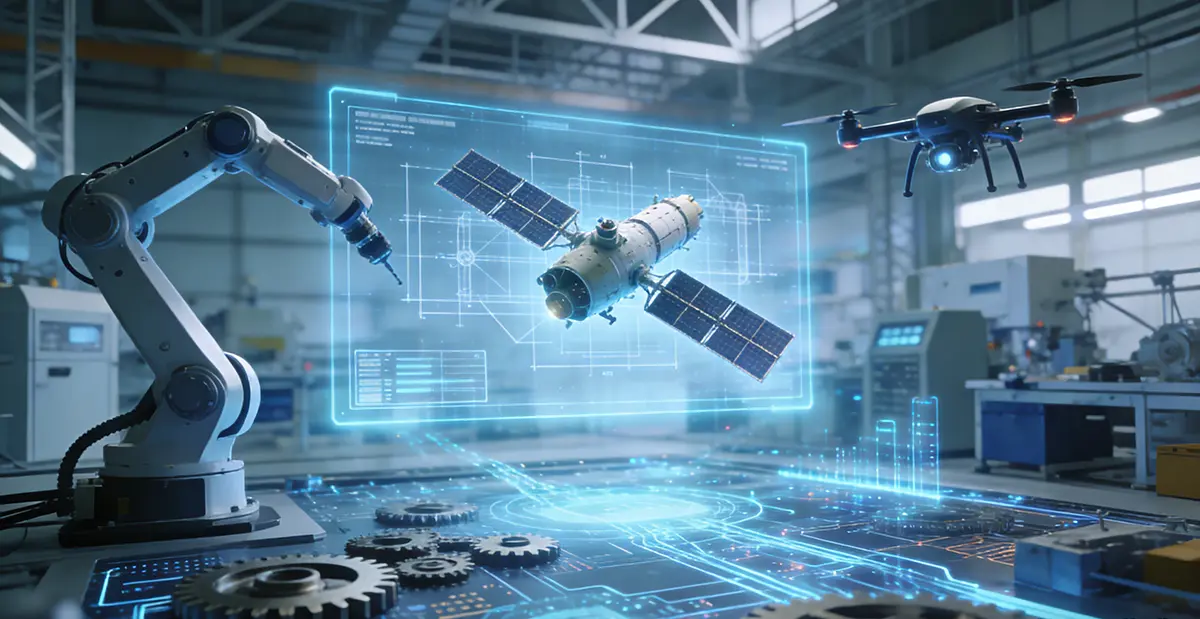
1. Introduction to the Mechanical and Aerospace Engineering Major
The Mechanical and Aerospace Engineering Major is a high-end interdisciplinary field that merges classical mechanical engineering principles with the specialized requirements of the aerospace domain. It focuses on the design, analysis, manufacturing, testing, and control of aircraft (including airplanes, spacecraft, missiles, satellites) and their associated propulsion systems. This discipline requires students to establish a robust foundation in mechanical engineering while mastering specialized knowledge areas such as Aerodynamics, Flight Mechanics, Propulsion Systems, and Aerospace Materials. It serves as a core engineering discipline underpinning the advancement of national aerospace capabilities.
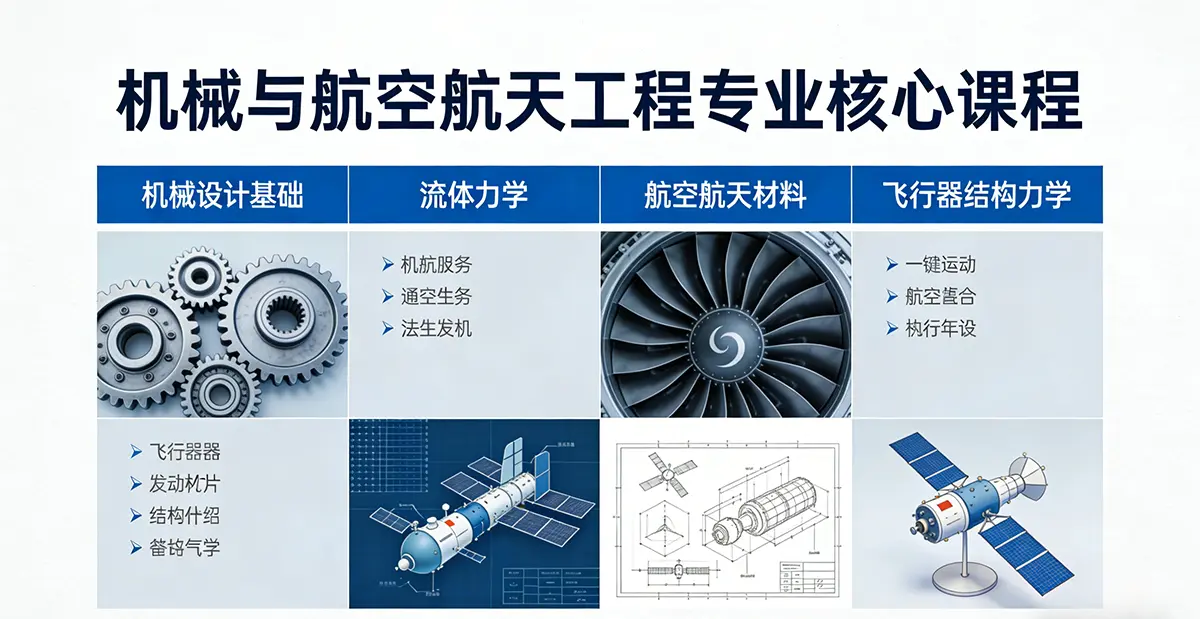
2. Major Courses in the Mechanical and Aerospace Engineering Major
| Module Category | Core Courses |
| Foundational Engineering Science | Advanced Mathematics, Linear Algebra, Probability and Statistics, University Physics, Theoretical Mechanics, Mechanics of Materials, Engineering Thermodynamics, Fluid Mechanics |
| Mechanical Engineering Core | Principles of Machinery, Mechanical Design, Engineering Materials, Fundamentals of Manufacturing Technology, Fundamentals of Control Engineering, Electrical and Electronic Technology |
| Aerospace Engineering Core | Aerodynamics, Flight Dynamics, Aircraft Structural Design and Analysis, Principles of Aerospace Propulsion (Engines), Aircraft Systems Design |
| Analytical Computation and Simulation | Computer-Aided Design (CAD, e.g., CATIA/SolidWorks), Fundamentals of Computational Fluid Dynamics (CFD), Finite Element Analysis (FEA), Aircraft Dynamics Modeling and Simulation |
| Specialized Electives and Frontiers | Composite Structures, Spacecraft Attitude Dynamics and Control, Rocket Engine Technology, Unmanned Aerial Vehicle (UAV) Systems, Aerospace Materials, Fundamentals of Airworthiness Management |
3. Advanced Study Pathways for the Mechanical and Aerospace Engineering Major
Master's/PhD in Aerospace Engineering: Conduct specialized in-depth research in areas such as aircraft design, propulsion technology, aerodynamics, and structural health monitoring.
Master's in Mechanical Engineering: Broaden and deepen expertise in wider mechanical fields including robotics and advanced manufacturing.
Master's/PhD in Mechanics (Solid Mechanics, Fluid Mechanics): Engage in more fundamental theoretical and computational research.
Materials Science and Engineering: Specialize in advanced aerospace materials such as composites and high-temperature alloys.
Control Science and Engineering: Focus on aircraft Navigation, Guidance, and Control (GNC).
Systems Engineering / Engineering Management: Transition towards the management and integration of complex engineering systems.
MBA: Pursue careers in management or investment within the aerospace industry.
4. Career Paths and Positions for the Mechanical and Aerospace Engineering Major
Employment is characterized by distinct industry concentration and high entry barriers, primarily serving national aerospace strategies and the high-end manufacturing sector.
Core Employment Sectors
Aerospace R&D and Design Institutions (Primary Destination):
Research institutes and design bureaus under AVIC, COMAC, AECC, etc.: Aerodynamic Design Engineer, Structural Strength Engineer, Flight Control System Engineer, Propulsion System Engineer, Systems Integration Engineer.
Research institutes under China Aerospace Science and Technology Corporation (CASC) and China Aerospace Science and Industry Corporation (CASIC): R&D and design positions within overall design, structural, and propulsion departments.
High-End Manufacturing:
Aircraft manufacturers (e.g., XAC, CAC, SAC): Process Engineer, Assembly Engineer, Digital Manufacturing Engineer.
Aero-engine companies: Blade Design Engineer, Engine Assembly and Test Engineer.
Civil Aviation and Operations Support:
Airlines: Maintenance Engineering Department, roles in aircraft continuing airworthiness and maintenance engineering management.
Civil Aviation Administration / Airworthiness Certification Centers: Airworthiness Certification Engineer.
Emerging and Related Fields
UAVs / eVTOL (Electric Vertical Takeoff and Landing) Aircraft: Systems Design Engineer, Flight Control Algorithm Engineer, Structural Engineer.
Commercial Space: R&D positions at emerging commercial rocket and satellite companies.
High-End Equipment and Automotive Industries: Applying expertise in aerodynamics, lightweight structures, and vibration control to fields like Formula 1 racing, high-speed trains, and wind turbine blades.
Research Institutes and Universities: Researcher, Faculty Member (typically requires a PhD).
5. Employment Rate and Industry Trends for the Mechanical and Aerospace Engineering Major
Employment Rate Characteristics
“Strong National Strategic Orientation, High Industry Barriers”: Employment is heavily dependent on national aerospace project funding and industrial development plans, leading to noticeable industry cycles. Positions in core state-owned entities are stable, but hiring volumes are subject to project planning.
Prominent Advantage of Prestigious Universities and Advanced Degrees: Leading aerospace research institutes and manufacturers tend to recruit from a concentrated pool of elite universities. A Master's degree or higher is the predominant requirement for entry into core R&D and design roles.
Compensation and Career Development: Starting salaries within state-owned enterprises may be less competitive compared to the internet sector, but they offer comprehensive benefits and stable, long-term career paths where deep technical expertise accrues significant value. The commercial space sector often provides more market-competitive compensation packages.
Industry Development Trends
Green Aviation and Electrification: Sustainable Aviation Fuel (SAF), hydrogen energy, and hybrid/all-electric propulsion are key R&D priorities for next-generation aircraft.
Smart Manufacturing and Digitalization: The application of digital twins for full aircraft lifecycle management, automated composite layup, and additive manufacturing (3D printing) for complex components is becoming increasingly widespread.
Commercial Space and Low-Earth Orbit Constellations: Satellite internet (e.g., Starlink), space tourism, and reusable launch vehicles are driving rapid growth in the commercial space industry chain.
UAVs and Urban Air Mobility: Cargo drones and eVTOLs are pioneering new markets and application scenarios.
Hypersonic and Air-Space Fusion Vehicles: Representing a strategic frontier for future aerospace technology, involving cutting-edge research in aerodynamics, thermal protection, and propulsion under extreme conditions.
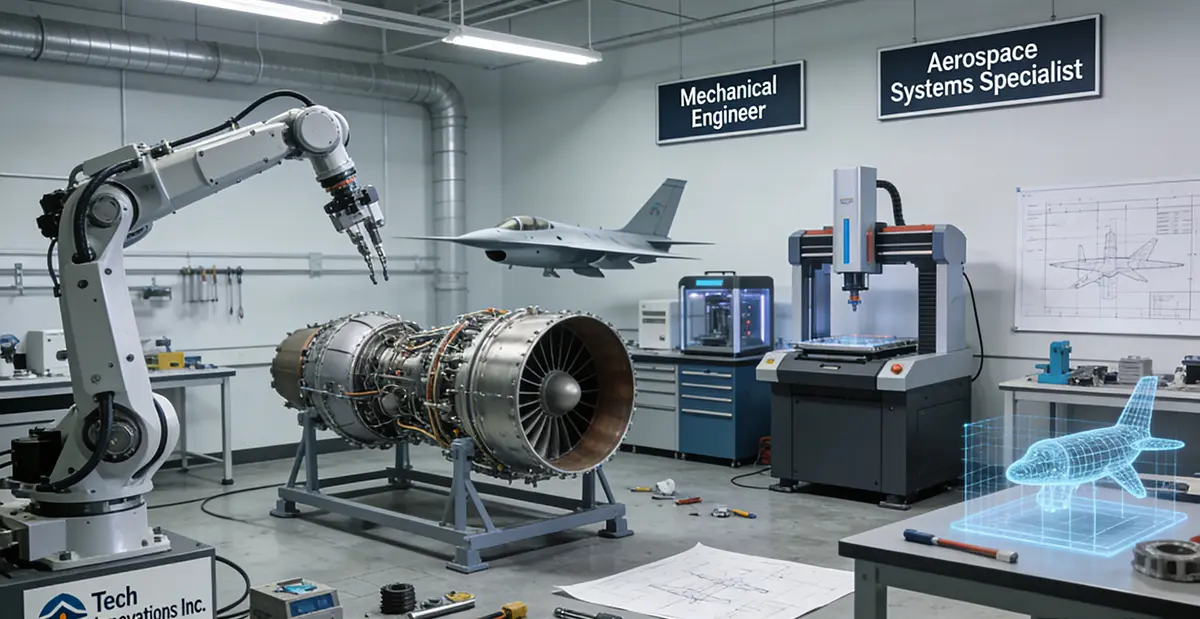
6. Major Global Institutions Offering the Mechanical and Aerospace Engineering Major
| Country/Region | Representative Institutions (Top Institutions in Mechanical and Aerospace Engineering) |
| United States | Massachusetts Institute of Technology (MIT), Stanford University, California Institute of Technology (Caltech), University of Michigan–Ann Arbor, Purdue University (historically strong in aerospace) |
| United Kingdom | University of Cambridge, Imperial College London, Cranfield University (postgraduate-only, with a distinct aerospace focus) |
| Europe | RWTH Aachen University (Germany), Delft University of Technology (Netherlands), ISAE-SUPAERO (France) |
| Russia | Moscow Aviation Institute (MAI) |
| China | Beihang University (BUAA), Northwestern Polytechnical University (NPU), Harbin Institute of Technology (HIT), Nanjing University of Aeronautics and Astronautics (NUAA), Tsinghua University |
| Other | University of Waterloo (Canada), University of Sydney (Australia) |
DisciplineMajor Recommendations
Ideal Candidates for the Mechanical and Aerospace Engineering Major:
Individuals with a passion for and curiosity about flight and space exploration, coupled with a strong sense of national pride and mission.
Those who possess exceptional mathematical and scientific foundations, spatial visualization skills, and systems thinking capabilities.
Candidates willing to undergo rigorous professional training, adapt to a conservative industry culture, and potentially work in environments requiring security clearance.
Individuals who value a long-term perspective and deep technical specialization over chasing short-term market trends.
Core Competencies of the Mechanical and Aerospace Engineering Discipline:
A solid theoretical foundation in Aerodynamics, Structural Mechanics, and Flight Dynamics.
The ability to design, analyze, and integrate complex systems (aircraft/spacecraft).
Proficiency in using specialized engineering software (e.g., CATIA, ANSYS, Fluent/CFX) for modeling and simulation.
A rigorous adherence to engineering standards and a strong spirit of teamwork.
Study Recommendations for the Mechanical and Aerospace Engineering Major:
Aim for outstanding grades in mathematics, science, and core engineering courses: These are crucial credentials for entering leading organizations.
Actively participate in major research projects or competitions: Such as aircraft design competitions, innovation challenges, or faculty-led research to gain practical experience.
Achieve proficiency in at least one mainstream industry design/analysis software and understand its associated workflow.
Secure internships at target employers to gain early industry insight and build professional networks.
Strengthen programming and algorithmic skills (Python/C++): These are critical for flight control systems, simulation, and data processing tasks.
Maintain good physical health and mental resilience to handle potential pressures and challenges.
Note: Some institutions may categorize this Major under different academic departments. Please refer to the specific classification used by your chosen institution.
- The Previous Passage:Mechanical Engineering(Mech. Eng.)_机械工程
- The Next Passage:Computer Science and Engineering(Comput. Sci. Eng.)_计算机科学与工程
Human Geography Major_Geography(Geog.)_人文地理
The Human Geography Major explores the complex relationships between human activities and space, cul···

Atmospheric Sciences(Atmos. Sci.)_大气科学
Atmospheric science is the study of phenomena and evolutionary patterns within Earth's atmospher···
Earth Sciences(Earth Sci.)_地球科学
The Earth Science major focuses on studying the Earth system and its interactions, providing a scien···

Ocean Sciences(Ocean Sci.)_海洋科学
PbootCMS是全新内核且永久开源免费的PHP企业网站开发建设管理系统,是一套高效、简洁、 强悍的可免费商用的···

