

Computer Science and Engineering(Comput. Sci. Eng.)_计算机科学与工程
Time:2026-03-25 Visits:1
Computer Science and Engineering
Computer Science and Engineering serves as the core driving force behind global transformation today. From artificial intelligence to quantum computing, from big data to cybersecurity, it is reshaping every facet of human society. In 2026, amidst the rapid iteration of AI technologies, this field is undergoing a profound transition from its “Golden Age” to an era of “Evolutionary Reinvention.”
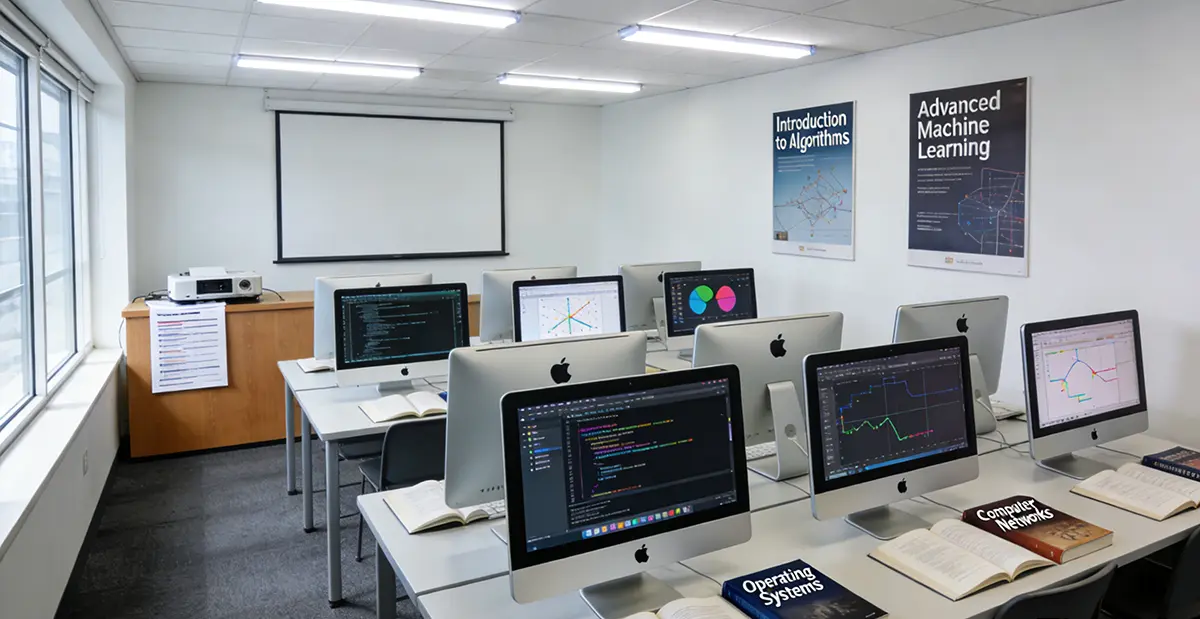
Introduction to Computer Science and Engineering Major
Computer Science and Engineering is a comprehensive discipline that explores computer system design, software development, algorithmic theory, and the application of computational technology to solve real-world problems. Internationally, it typically encompasses three interconnected yet distinct fields: Computer Science (CS), Computer Engineering (CE), and Electrical and Computer Engineering (ECE).
- Computer Science (CS): Focuses on computational theory, algorithms, data structures, artificial intelligence, and software design. Emphasizes software development and theoretical research, ideal for students with a strong interest in programming and algorithms.
- Computer Engineering (CE): Concentrates on the design and development of computer hardware and software, integrating knowledge from electrical engineering and computer science. Research areas include computer system design, embedded systems, networking, and communications.
- Electrical and Computer Engineering (ECE): Typically merges computer engineering and electrical engineering, covering a broader scope including communication systems, signal processing, and control systems.
If modern society were likened to an organism, computer science and engineering are the architects of its “digital nervous system”—algorithms are its thought processes, software its behavioral patterns, and hardware its senses and muscles, collectively forming the infrastructure of our era.
Core Courses at International Institutions
Computer science programs at top global universities emphasize integrating theory with practice, typically following a modular structure of “core fundamentals + specialized depth + integrated projects.”
Core Fundamentals Module:
- Mathematical Foundations: Advanced Mathematics, Linear Algebra, Probability and Mathematical Statistics, Discrete Mathematics
- Programming Fundamentals: Introduction to Java Programming, Python, C/C++
- Data Structures and Algorithms: Data Structures, Algorithm Design and Analysis
Specialization Modules (Example: Stevens Institute of Technology):
- Systems and Architecture: Systems Programming, Computer Organization and Programming, Introduction to Operating Systems
- Databases and Networking: Database Management Systems, Computer Networking Principles
- Web and Mobile Development: Web Programming, Mobile Systems and Applications
- Artificial Intelligence: Applied Machine Learning
- Software Engineering: Agile Software Development Methods
- Human-Computer Interaction: Human-Computer Interaction
Integrated Practice Module (Example: Aalto University):
- Specialization Tracks: Algorithms and Computing, Big Data and Large-Scale Computing, Secure Systems, Software Systems and Technologies, Human-Computer Interaction, Machine Learning/Data Science/AI, Software and Service Engineering
- Master's Thesis: 30-credit research project, typically closely integrated with industry or cutting-edge research
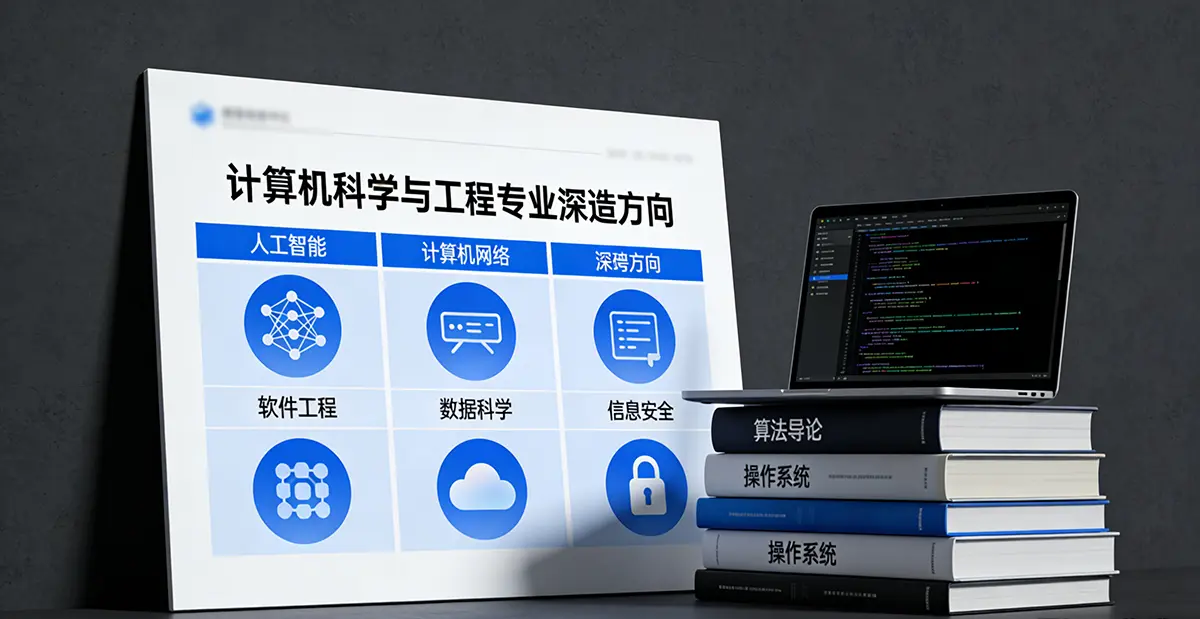
Advanced Study Pathways in Computer Science and Engineering Major
Research directions at the master's and doctoral levels are highly specialized and cutting-edge. Based on research areas at institutions like Qingdao University and the curriculum structure at Aalto University, key focus areas include:
Core Theoretical Directions:
- Algorithms and Computational Complexity: Computability theory, algorithm design and analysis, computational complexity theory
- Formal Methods: Programming Language Theory, Logic and Reasoning
Systems and Architecture:
- Computer System Design: Multiprocessor Communication Design, Network Design, Memory Systems
- Distributed Systems and Cloud Computing: Large-Scale Distributed Systems, Cloud-Native Architectures
- Embedded Systems and IoT: Real-time Embedded Systems, Networked Device Security
Artificial Intelligence and Data Science:
- Machine Learning and Deep Learning: Supervised Learning, Unsupervised Learning, Reinforcement Learning, Deep Neural Networks
- Computer Vision and Image Processing: Image Recognition, Object Detection, Image Generation
- Natural Language Processing: Speech Recognition, Semantic Understanding, Machine Translation
- Big Data Analytics: Large-Scale Data Mining, Urban Computing
Emerging Interdisciplinary Areas:
- Robotics and Embodied Intelligence: Integrating code with physical world feedback to develop intelligent robots
- Bioinformatics and Computational Biology: Protein Folding Prediction, Molecular Drug Design
- New Energy and Climate Technology: Grid scheduling optimization, carbon capture technology simulation
- Cybersecurity and Privacy Computing: Cryptography, network and system security, post-quantum cryptography
Software and Development Methods:
- Software Engineering: Agile development, DevOps, software testing
- Human-Computer Interaction and Visualization: User interface design, information visualization
- Web Technology and Applied Science: Web protocols, Semantic Web
International Career Paths and Positions
Computer Science and Engineering graduates remain in high demand globally, though the market has undergone structural shifts since 2025.
Core Employment Sectors:
| Sector | Typical Employers | Representative Positions |
| Tech Giants | Google, Microsoft, Meta, Amazon | Software Engineer, Algorithm Engineer, Systems Architect |
| AI/Machine Learning | OpenAI, DeepMind, AI Startups | Machine Learning Engineer, AI Researcher, Data Scientist |
| FinTech | Goldman Sachs, JPMorgan Chase, Quantitative Hedge Funds | Quantitative Analyst, Financial Software Engineer, Risk Management |
| Cybersecurity | Security firms, government agencies | Security Engineer, Penetration Tester, Cryptography Specialist |
| Cloud Computing & Infrastructure | AWS, Azure, Alibaba Cloud | Cloud Engineer, DevOps Engineer |
| Emerging Tech Fields | Robotics companies, Biotech companies | Embodied Intelligence Engineer, Computational Biologist |
| Startups | Various tech startups | Full-Stack Engineer, Technical Partner |
Representative Global Positions (Based on Latest Industry Data):
1. Software Engineer: Designs, develops, and maintains software systems across frontend, backend, mobile, and full-stack domains
2. Machine Learning Engineer: Builds and deploys machine learning models, optimizes algorithm performance, applies AI to solve real-world problems
3. Data Scientist: Extract insights from massive datasets to inform business decisions and build predictive models
4. Security Engineer: Protect systems and data integrity, conduct penetration testing, and counter cyber threats
5. Cloud Engineer: Design and manage cloud infrastructure while optimizing system performance and scalability
6. Systems Architect: Oversee end-to-end architecture design for large-scale systems, ensuring reliability, scalability, and performance
International Employment Rates and Industry Trends
Employment Rates and Salaries:
- Salary Levels: U.S. computer engineering graduates (with less than 5 years of experience) earn an average annual income of $60,500. Those with 5-10 years of experience average $80,800, while those with 10-20 years average $104,000. Computer engineering graduates achieve a median annual salary of $80,000 (approximately RMB 570,000) within five years of graduation, ranking first among all majors.
- Employment Challenges: However, the landscape has shifted since 2025. Research from the Federal Reserve Bank of New York indicates unemployment rates for computer science graduates range from 6.1% to 7.5%—twice that of biology and art history graduates. Since early 2025, major tech companies have laid off over 100,000 employees.
Industry Trends:
1. AI Reshaping Employment Structure: The World Economic Forum's “Future of Jobs Report 2025” indicates that due to AI advancements, approximately 41% of global companies expect to reduce their workforce over the next five years. Entry-level and mid-level positions, which can be partially replaced by AI tools, face the greatest impact.
2. Talent Polarization Intensifies:
- Top Talent: Companies compete fiercely with high salaries and stock options for elite professionals mastering critical models and platform capabilities.
- Entry/Mid-Level: Demand eroded by AI tools and automation, leading to continuous job contraction.
3. Talent Flows Toward Four Emerging Frontiers:
- Robotics and Embodied Intelligence: Integrating code with physical world feedback.
- Bioinformatics and Synthetic Biology: Computational biology emerges as a new hotspot
- Renewable Energy and Climate Tech: Grid scheduling optimization, carbon capture technology simulation
- Cybersecurity and Privacy Computing: Defense demands grow exponentially
4. Skill requirements evolve: By 2030, technical roles in big data, fintech, and AI will double. Future developers will require not just programming language proficiency, but deep understanding of system architecture and domain expertise.
5. “AI Job-Hunting Doom Loop”: Students rely on generative AI to mass-produce resumes, while companies use AI systems for rapid screening—creating mutual automation that drastically lowers overall job conversion rates.
Ideal Candidates for Computer Science and Engineering Major
You'll gain a competitive edge internationally if you possess these traits:
1. Genuine passion for technology: Driven not just by high salaries, but by innate curiosity and exploration of programming, algorithms, and systems
2. Strong mathematical foundation: Advanced calculus, linear algebra, and discrete mathematics form the cornerstone for understanding algorithms and theory
3. Rigorous logical thinking: Ability to abstract problems, decompose complex tasks, and reason systematically
4. Strong problem-solving skills: Thrives on challenges, remains resilient when encountering bugs, and possesses patience for persistent debugging
5. Self-directed learning: Rapid technological evolution demands continuous mastery of new languages, frameworks, and tools
6. Teamwork and communication: Modern software development is a collaborative endeavor requiring strong coordination abilities
7. Adaptability to Change: Embrace the industry's structural transformation and be open to transitioning into emerging fields
Core Competencies of Computer Science and Engineering Major
The core competencies of this field are evolving beyond mere “programming skills” toward deeper capabilities:
Algorithmic Thinking & Problem Abstraction: Ability to abstract complex problems into computational models and design efficient algorithmic solutions. This represents the core domain where AI struggles to achieve full replacement.
System Architecture and Design: Understanding the holistic architecture of large-scale systems and designing scalable, reliable, high-performance systems—beyond merely writing code modules.
Interdisciplinary Knowledge Integration: Deeply integrating computational thinking with other fields (biology, physics, finance, healthcare) to solve complex scientific and engineering problems.
Continuous Learning and Technological Acumen: In an era of accelerating technological iteration, the ability to rapidly master new tools, frameworks, and paradigms is paramount.
Engineering Practice and Problem Solving: Translating theory into operational systems while navigating real-world uncertainties and complexities.
Human-AI Collaboration in the AI Era: Effectively leverage AI tools to enhance development efficiency while understanding their limitations, making human judgments and optimizations at critical junctures.
Major Institutions Globally Offering Programs (Selected Schools - Listed in no particular order)
China
The Hong Kong University of Science and Technology、The Chinese University of Hong Kong、Tsinghua University、Shanghai Jiao Tong University、Zhejiang University、University of Science and Technology of China、Peking University、Wuhan University、University of Electronic Science and Technology of China、Southeast University
United Kingdom
University of Oxford
Singapore
Nanyang Technological University、National University of Singapore
United States
Massachusetts Institute of Technology、Stanford University、University of California, Berkeley、Princeton University、Carnegie Mellon University、Harvard University
Canada
University of Toronto
Other Strong Institutions: Georgia Institute of Technology, University of Texas at Austin, Purdue University-West Lafayette, Harbin Institute of Technology, Beihang University, University of Illinois at Urbana-Champaign, City University of Hong Kong, Hong Kong Polytechnic University, ETH Zurich, Imperial College London, University of Cambridge, etc.
Leading Institutions in Mainland China: Tsinghua University, Shanghai Jiao Tong University, Zhejiang University, University of Science and Technology of China, Peking University, Wuhan University, University of Electronic Science and Technology of China, Southeast University, Harbin Institute of Technology, Beihang University, Xidian University, Beijing Institute of Technology, Huazhong University of Science and Technology, Nanjing University, South China University of Technology, Chongqing University of Posts and Telecommunications, Fudan University, Sun Yat-sen University, Shenzhen University, Xi'an Jiaotong University, Dalian University of Technology, Shandong University, Southern University of Science and Technology, etc.
Recommended Learning Path for Computer Science and Engineering Major
1. Build a Solid Foundation (Undergraduate Stage): Focus on mathematics, programming, and data structures. Master advanced mathematics, linear algebra, and discrete mathematics—the cornerstones of algorithms and theory. Become proficient in at least one programming language (Java/Python/C++), and deeply understand data structures and algorithms. Write code frequently and participate in course projects.
2. Build Professional Framework (Mid-to-Late Undergraduate): Deepen knowledge in core courses like Operating Systems, Computer Networks, Databases, and Software Engineering. Select a specialization based on interests (AI, Systems, Security, etc.). Actively engage in course design and practical projects to accumulate project experience.
3. Focus and Deepen (Master's Stage): Choose a research direction aligned with interests, such as Machine Learning, Computer Vision, or Distributed Systems. Actively seek industry internships, especially at tech companies or startups. Contribute to open-source projects to gain practical development experience. For your master's thesis, prioritize topics closely aligned with industry needs or cutting-edge research.
4. Plan for the Future and Adapt to Change (Throughout Your Journey):
- Technical Depth + Domain Expertise: In an era where AI auto-coding is becoming widespread, pure coding skills alone are losing value. Expand your capabilities into system architecture, domain knowledge, and interdisciplinary fields.
- Monitor Emerging Frontiers: Robotics, bioinformatics, climate tech, and cybersecurity represent the four major talent migration directions.
- Project Experience Reigns Supreme: Actively engage in real-world projects—whether through academic research, corporate internships, or open-source contributions. Project experience outweighs course grades in interviews.
- Cultivate Continuous Learning Habits: Rapid technological iteration demands tracking cutting-edge advancements. Monitor top conference papers, technical blogs, and open-source communities.
- Develop Soft Skills: Communication, teamwork, and project management become increasingly vital throughout your career.
- English Proficiency: An international industry requires strong English communication skills, particularly for reading technical documentation and global collaboration.
- The Previous Passage:Mechanical and Aerospace Engineering(Mech. Aerosp. Eng.)_机械和航空航天工程
- The Next Passage:Computational Science and Engineering(Comput. Sci. Eng.)_计算科学与工程

Human Geography Major_Geography(Geog.)_人文地理
The Human Geography Major explores the complex relationships between human activities and space, cul···

Atmospheric Sciences(Atmos. Sci.)_大气科学
Atmospheric science is the study of phenomena and evolutionary patterns within Earth's atmospher···

Earth Sciences(Earth Sci.)_地球科学
The Earth Science major focuses on studying the Earth system and its interactions, providing a scien···

Ocean Sciences(Ocean Sci.)_海洋科学
PbootCMS是全新内核且永久开源免费的PHP企业网站开发建设管理系统,是一套高效、简洁、 强悍的可免费商用的···

