

Mathematics(Math)_数学
Time:2026-04-21 Visits:4
Mathematics
Mathematics is hailed as the queen of sciences, serving as the foundational language for understanding all phenomena in the world. In the era of AI and big data, the “high adaptability” and “strong logical reasoning” cultivated by mathematics majors have become their unique competitive edge, offering career prospects far broader than the traditional perception of “becoming a teacher.”
Introduction to Mathematics Programs
Mathematics is a discipline that explores concepts such as quantity, structure, change, space, and information. It transcends mere computation, embodying abstract logical thinking and language. Mathematics programs aim to equip students with fundamental theories and methodologies of mathematical science, enabling them to apply mathematical knowledge, construct mathematical models, and utilize computers to solve real-world problems.
Undergraduate programs typically admit students into broad categories, with specializations later branching into:
- Mathematics and Applied Mathematics (focusing on fundamental theory and applications)
- Information and Computational Science (emphasizing computational methods and information technology)
- Statistics (centering on data analysis)

Core Courses in the Mathematics Program
The mathematics curriculum is rigorous and systematic, designed to build a robust mathematical foundation. Core courses typically include:
- Three Foundational Pillars
- Mathematical Analysis: Formalization of calculus, serving as the cornerstone of all analysis.
- Advanced Algebra: Study of linear spaces and linear transformations, initiating abstract reasoning.
- Analytical Geometry: Algebraic investigation of geometric figures, establishing connections between numbers and shapes.
- Core Advanced Courses
- Analysis Track: Real Analysis, Complex Analysis, Functional Analysis, Ordinary/Partial Differential Equations.
- Algebra and Geometry Track: Abstract Algebra, Differential Geometry, Topology.
- Applied and Probability Track: Probability Theory, Mathematical Statistics, Mathematical Modeling, Operations Research and Optimization, Computational Methods.
Further Study Paths for Mathematics Major
After completing their undergraduate degree, many mathematics majors choose to pursue advanced studies. Research directions can be broadly categorized into pure mathematics and applied mathematics:
- Pure Mathematics: Focuses on the study of mathematical theory itself, such as number theory, algebraic geometry, differential geometry, topology, and dynamical systems. Suitable for students aspiring to engage in mathematical research or become mathematicians.
- Applied Mathematics: Utilizes mathematical tools to solve practical problems in other fields. Popular directions include:
- Computer Science & AI: Computer Graphics, Machine Learning, Pattern Recognition, Information Theory.
- Finance & Economics: Financial Mathematics, Actuarial Science, Quantitative Economics.
- Interdisciplinary Fields: Computational Biology, Biomathematics, Operations Research & Cybernetics.
- Data Science: Big Data Analysis, Statistics.
Career Paths and Positions for Mathematics Major
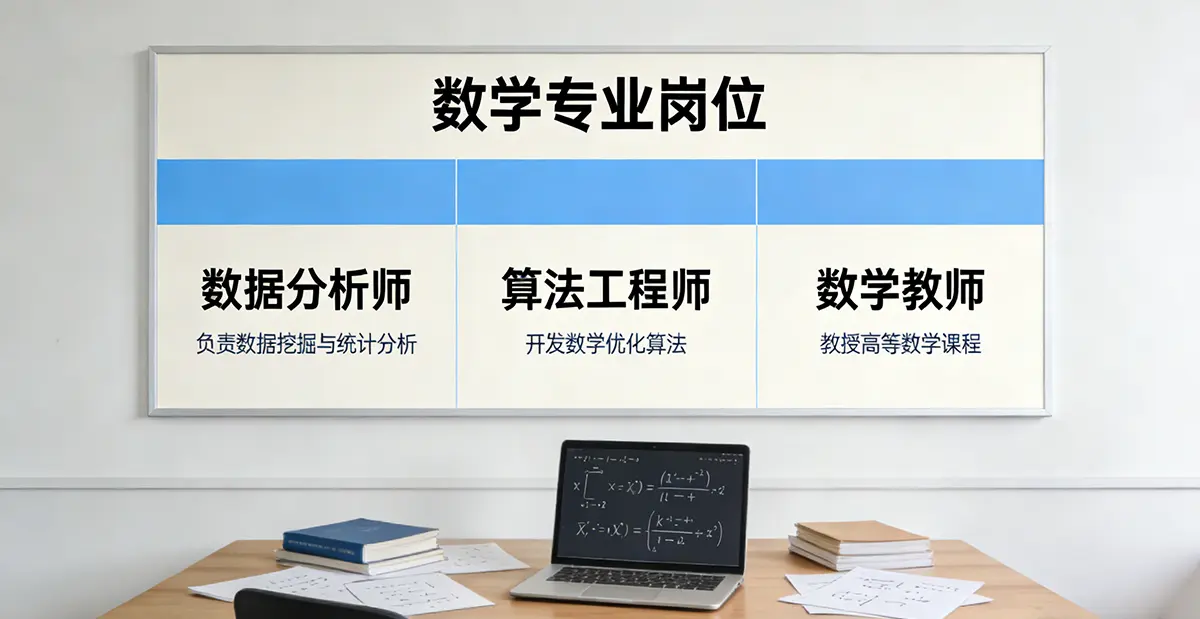
Mathematics graduates are hailed as “jack-of-all-trades” in the job market, highly sought after for their robust logical thinking and quantitative analysis skills. Primary employment sectors and roles include:
- Technology/Internet — In the AI era, mathematics forms the core technology, driving strong demand for mathematical talent in this field with competitive salaries.
- Roles: Algorithm Engineer, Data Analyst, Machine Learning Engineer, Software Development Engineer.
- Finance/Insurance — Mathematical models form the foundation for financial product pricing and risk assessment, making mathematical talent indispensable.
- Roles: Quantitative Researcher, Risk Control Analyst, Actuary, Financial Engineering Analyst.
- Education/Research — Teaching mathematical knowledge and cultivating the next generation of talent offers a stable and respected career path.
- Positions: University Professor/Researcher, K-12 Math Teacher, Educational Institution Instructor.
- Government/Enterprise: Responsible for data statistics, economic analysis, and policy research.
- Positions: Civil servants or researchers in departments like Statistics Bureaus and Economic Information Centers.
- High-Tech Manufacturing: Mathematics is the key tool for solving core problems in these fields.
- Positions: Researchers in smart manufacturing, chip design, aerospace, and related sectors.
Employment Rate and Industry Trends for Mathematics Major
- Employment Rate & Salary: Graduates in mathematics-related majors maintain stable employment rates, with notably higher proportions entering emerging sectors like fintech and big data. Data indicates a high proportion of math graduates pursue careers in technology, where their average monthly salaries demonstrate strong market competitiveness.
- Industry Trends: In the era of digital intelligence, mathematics is increasingly recognized as a “meta-skill,” its importance growing ever more prominent.
1. “Mathematics+” Interdisciplinary Integration: The convergence of mathematics with AI, finance, biology, and other fields is intensifying, spawning numerous emerging roles.
2. Emerging Core Competitiveness: Mathematical talent possesses a foundational understanding and tool development capabilities, making them less susceptible to replacement by AI and enhancing their overall employment competitiveness.
3. Expanding Application Frontiers: From traditional research and education to emerging sectors like internet and fintech, the boundaries of mathematical application continue to broaden.
Ideal Candidates for Mathematics Major
1. Interest-Driven: Genuine passion and curiosity for mathematics, unafraid of abstract symbols and rigorous logic.
2. Strong Logical Thinking: Skilled at meticulous analysis, precise reasoning, and distilling fundamental patterns from complex phenomena.
3. Patience and Focus: Willing to endure long periods of contemplation and deduction, capable of sitting through the “cold bench.”
4. Thoughtful Inquiry: Unsatisfied with rote memorization, eager to explore the “why” behind formulas and theorems.
5. Proactive Exploration: Able to take abstract concepts learned in class and actively apply them to practical tasks like programming and modeling.
The Core Competencies of a Mathematics Major
The core competencies of a mathematics major lie not in memorizing specific formulas, but in a set of transferable thinking skills:
- Logical reasoning: This is the heart of mathematical training. The ability to rigorously analyze problems and construct flawless arguments is invaluable in any field—law, management, R&D, and beyond.
- Abstraction: The ability to distill core structures and relationships from concrete problems to build models. This is the key transition from “tool user” to “tool developer.”
- Quantitative Analysis: Proficiency in using data and models to understand and solve problems, crucial in finance, internet, and related industries.
- Pattern Recognition: The ability to identify patterns and regularities within complex information forms the foundation of data mining and machine learning.
Leading Institutions Worldwide
Mathematics is highly valued globally, with many top universities boasting strong mathematics departments. According to the 2025 Shanghai Ranking's World Class Disciplines, the following institutions excel in mathematics(Selected Institutions - No particular ranking):
1. United States
- Princeton University, Massachusetts Institute of Technology, Stanford University, Harvard University, University of California, Berkeley
- University of Chicago, New York University, University of California, Los Angeles, Columbia University, Yale University
2. France
- Université Paris-Saclay, Sorbonne University, Université Paris-Descartes
- Université Paris-Diderot, Université Grenoble Alpes, École Normale Supérieure de Lyon
3. United Kingdom
- University of Oxford, University of Cambridge, Imperial College London
- University of Warwick, University of Edinburgh, University of Manchester
4. Mainland China
- Tsinghua University, Peking University, Fudan University, Southern University of Science and Technology
- Shanghai Jiao Tong University, University of Science and Technology of China, Zhejiang University, Sichuan University, Harbin Institute of Technology, Nankai University, Xi'an Jiaotong University, Shandong University, Sun Yat-sen University, Wuhan University, Beijing Normal University, Huazhong University of Science and Technology, Nanjing University
5. Switzerland
- ETH Zurich, EPFL, University of Geneva
6. Other Countries
- Canada: University of Toronto, University of British Columbia, University of Waterloo
- Israel: Hebrew University of Jerusalem, Weizmann Institute of Science
- Japan: Kyoto University, University of Tokyo
- Singapore: National University of Singapore
Recommended Learning Path for Mathematics Major
1. Build a Solid Foundation: Core courses are your lifeline. Thoroughly master mathematical analysis, advanced algebra, and analytic geometry—grasp concepts deeply, derive theorems yourself, and don't just focus on solving problems. Simultaneously, learn a programming language (like Python) early to prepare for future applications.
2. Explore Your Path: Discover the allure of theoretical mathematics through courses like Real Analysis and Abstract Algebra, while experiencing the joy of applied mathematics in courses such as Mathematical Modeling and Operations Research to identify your interests. Actively participate in national competitions like the Mathematical Olympiad and Mathematical Modeling Contest to hone your skills.
3. Deepen and Expand: Elect advanced courses aligned with your interests, such as Topology, Functional Analysis, or interdisciplinary subjects like Financial Mathematics and Machine Learning. Strive to join a faculty research group to participate in scientific projects or undertake undergraduate innovation initiatives. If planning to enter the workforce directly, use winter and summer breaks to seek relevant internships and gain practical experience.
4. Lifelong Learning: The journey of mathematical learning has no endpoint. Maintain curiosity and a spirit of exploration through reading popular science books, watching open lectures, and attending academic seminars.
- The Previous Passage:Biological Anthropology(Biol. Anthrop.)_生物人类学
- The Next Passage:Astronomy(Astron.)_天文学

Human Geography Major_Geography(Geog.)_人文地理
The Human Geography Major explores the complex relationships between human activities and space, cul···

Atmospheric Sciences(Atmos. Sci.)_大气科学
Atmospheric science is the study of phenomena and evolutionary patterns within Earth's atmospher···
Earth Sciences(Earth Sci.)_地球科学
The Earth Science major focuses on studying the Earth system and its interactions, providing a scien···

Ocean Sciences(Ocean Sci.)_海洋科学
PbootCMS是全新内核且永久开源免费的PHP企业网站开发建设管理系统,是一套高效、简洁、 强悍的可免费商用的···

