

Computational Science and Engineering(Comput. Sci. Eng.)_计算科学与工程
Time:2026-03-26 Visits:3
Computational Science and Engineering Major
The Computational Science and Engineering Major integrates computing, mathematics, and domain science to solve complex problems. Discover its core curriculum, career paths in CAE, aerospace, and R&D, alongside trends in AI integration and digital twins shaping this interdisciplinary field.

1. Introduction to the Computational Science and Engineering Major
The Computational Science and Engineering Major is an interdisciplinary discipline established to integrate computer science, applied mathematics, and domain-specific knowledge (e.g., physics, engineering) to solve complex scientific and engineering problems. Its core lies in leveraging computational modeling, numerical simulation, data analysis, and high-performance computing techniques. Serving as the “third pillar” alongside theory and experimentation, this major drives scientific discovery and engineering innovation, specifically addressing complex system problems that are intractable by traditional methods.
2. Core Curriculum of the Computational Science and Engineering Major
| Module Category | Core Courses |
| Computer Science Fundamentals | Programming (C++/Python), Data Structures and Algorithms, Fundamentals of Parallel Computing, Software Engineering |
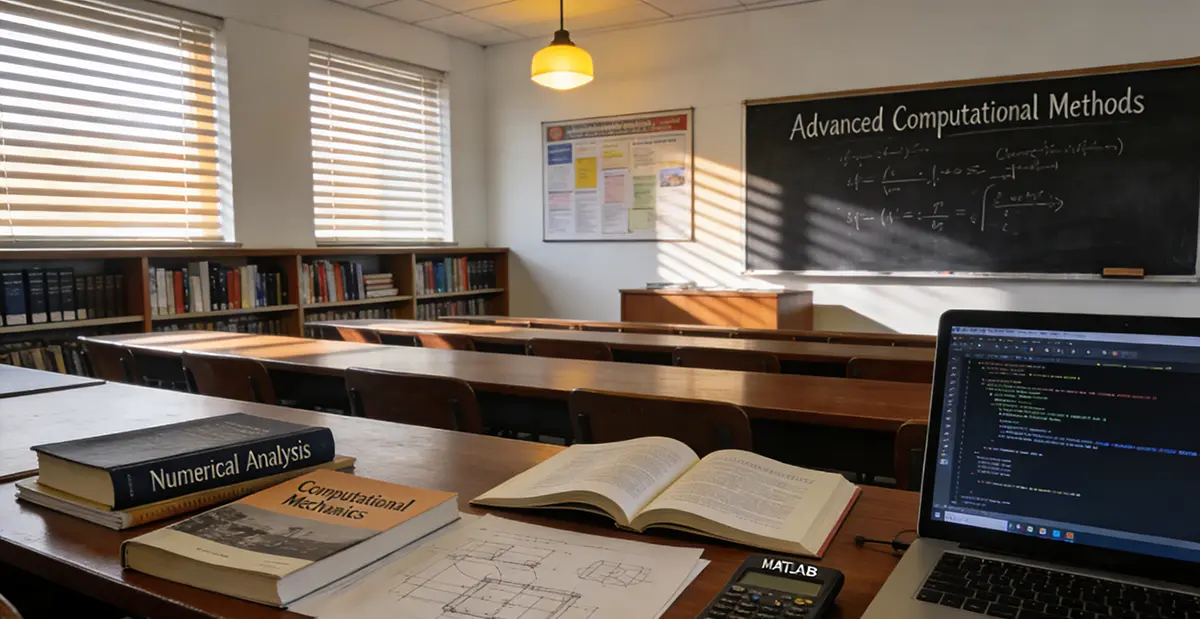
| Mathematics Core | Advanced Mathematics, Linear Algebra, Numerical Analysis (Numerical Linear Algebra, Numerical Solutions of Differential Equations), Probability Theory and Mathematical Statistics, Partial Differential Equations, Optimization Methods |
| Computational Science Core | Introduction to Scientific Computing, Computational Modeling and Simulation, High-Performance Computing (HPC), Computational Fluid Dynamics (CFD), Computational Solid Mechanics (FEA), Fundamentals of Computational Materials Science |
| Domain Science Foundations | University Physics (Mechanics, Electromagnetism, Thermodynamics), Engineering Mechanics (Theoretical Mechanics, Mechanics of Materials), Engineering Thermodynamics, Introduction to Fluid Mechanics |
| Tools and Visualization | MATLAB/NumPy/SciPy, Linux and Shell Programming, Scientific Data Visualization (e.g., Paraview) |
| Frontiers and Interdisciplinary | Applications of Machine Learning in Scientific Computing, Uncertainty Quantification, Multiscale Modeling |
3. Advanced Study Pathways for the Computational Science and Engineering Major
Master’s/PhD in Computational Science and Engineering: Pursue advanced research in areas such as computational fluid dynamics, computational solid mechanics, computational materials science, or computational biology.
PhD in Applied Mathematics/Computational Mathematics: Focus on theoretical innovation in numerical methods and algorithms.
PhD in Specific Engineering Fields (e.g., Aerospace, Mechanical, Energy): Employ computational science as a primary research tool.
Master’s in Data Science/Artificial Intelligence: Apply computational capabilities to broader data analysis and machine learning tasks.
Master’s in High-Performance Computing/Computer Science: Specialize in supercomputing architectures, system software, and application optimization.
4. Career Paths and Positions for Computational Science and Engineering Graduates
| Sector | Specific Positions and Directions |
| High-End Manufacturing R&D | Aerospace: CFD Engineer (aerodynamic
design, thermal protection), Structural FEA Engineer
Automotive: Crash Safety
Simulation Engineer, Aerodynamics Engineer, Battery Thermal Management
Simulation Engineer
Energy & Power: Fluid Flow Analysis Engineer for
Rotating Machinery, Nuclear Reactor Physics/Thermal-Hydraulics
Engineer
Electronics & Semiconductors: Chip Thermal & Electromagnetic
Simulation Engineer |
| Research Institutes & Universities | National Laboratories (e.g., Oak
Ridge, CAS institutes): Large-scale scientific computing
research
Universities: Professor, Researcher (typically requires PhD) |
| CAE Software Companies | ANSYS, Dassault Systèmes, etc.: Software Development Engineer (solver development), Technical Application Engineer/Consultant |
| Financial Engineering & Quantitative Analysis | Quantitative Analyst: Derivatives pricing and risk management using stochastic models, Monte Carlo simulation |
| Emerging Technology Fields | AI Research (AI for Science, e.g.,
AlphaFold)
Biotechnology & Pharmaceuticals: Computational
Chemist/Biologist for molecular dynamics simulation and drug design |
5. Employment Rates and Industry Trends for the Computational Science and Engineering Major
Employment Rate Characteristics: “High Barrier to Entry, High Specialization”: Positions are concentrated in technology-intensive industries and research institutions. Overall demand is relatively smaller than in computer science, but the professional barrier is extremely high, granting qualified candidates a unique advantage. High Academic Requirement: Core R&D and advanced application roles typically require a master’s degree or higher. Strong Salary Competitiveness: Engineers with profound computational science backgrounds command top-tier salaries among engineering disciplines in sectors like aerospace, CAE software, and cutting-edge R&D.
Industry Trends: Digital Twins and Industrial Metaverse: The drive to build high-fidelity virtual models of physical entities for prediction, optimization, and decision-making fuels demand for high-precision simulation technologies. Deep Integration of AI and Scientific Computing: Including physics-informed neural networks and machine learning-accelerated traditional numerical methods. Software and Algorithms for Heterogeneous Supercomputing (CPU+GPU): The advancement of exascale computing and AI necessitates talent skilled in developing and optimizing heterogeneous parallel programs. Multi-physics, Multi-scale Coupled Simulation: Addressing more complex real-world engineering problems. The Rise of Open-Source Scientific Computing Ecosystems.
6. Major Global Institutions Offering the Computational Science and Engineering Major
| Country/Region | Representative Institutions (Leading in Computational Science and Engineering) |
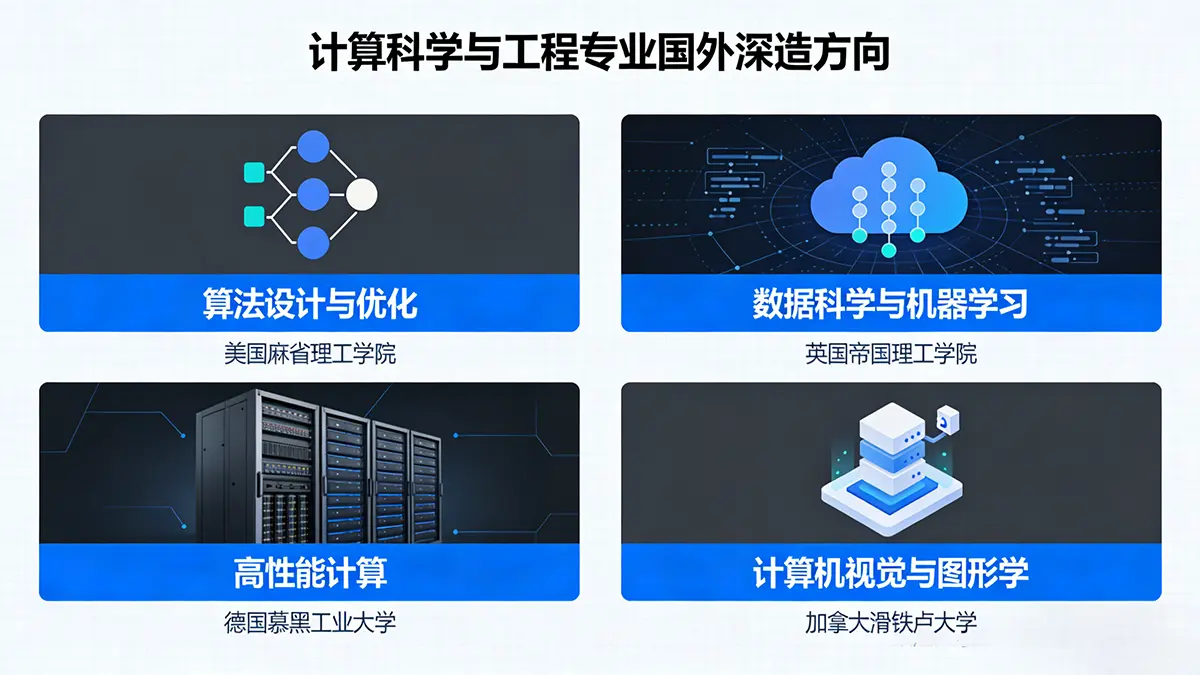
| United States | MIT (Center for Computational Science and Engineering), Stanford (Computational & Mathematical Engineering), UC Berkeley, University of Michigan, Brown University (Strong in Applied Math) |
| Germany | Technical University of Munich, RWTH Aachen University |
| Switzerland | ETH Zurich (Department of Computational Science and Engineering) |
| United Kingdom | Imperial College London, University of Oxford (Numerical Analysis Group) |
| China | Tsinghua University (Computational Science Program), Peking University (Computational & Applied Math), Shanghai Jiao Tong University, University of Science and Technology of China |
| Other | National University of Singapore, University of Waterloo (Applied Math & Computing) |
DisciplineMajor Recommendations
Ideal Candidates for the Computational Science and Engineering Major
Individuals with a strong interest in mathematical modeling and using computers to “experiment” on solving real-world physical problems. They should possess excellent mathematical and logical reasoning, abstract thinking abilities, and programming perseverance. They thrive in interdisciplinary work and enjoy creating value at the intersection of engineering, science, and computing. They are driven by a desire to understand the underlying physical mechanisms of problems and the essence of numerical methods, rather than settling for superficial application.
Core Competitiveness of the Computational Science and Engineering Major
The ability to translate physical/engineering problems into mathematical models and select/develop appropriate numerical methods. Skills in developing, debugging, and optimizing large-scale scientific computing programs. Critical analysis and validation capabilities for computational results (understanding model limitations and numerical errors). Proficiency in at least one scientific computing programming language/environment and one general-purpose programming language.
Study Recommendations for the Computational Science and Engineering Major
Establish a solid foundation in mathematics (especially numerical analysis and linear algebra) and physics. Learn high-performance computing and parallel programming (MPI, OpenMP, CUDA) early on. Gain in-depth mastery of at least one mainstream commercial (e.g., ANSYS) or open-source scientific computing software/library (e.g., FEniCS), understanding its underlying algorithms. Gain practical, in-depth experience in a specific application domain (e.g., fluids, structures, materials) through course projects or internships. Develop strong coding skills and software engineering practices (version control, documentation, modularity), as scientific code also requires maintainability and reproducibility. Stay current with technological frontiers by following top industry conferences (e.g., SC Supercomputing Conference, AIAA Aerospace Conference) and journals.
Note: Some institutions may categorize this major under different academic disciplines. Please refer to the specific classification used by the institution.
- The Previous Passage:Computer Science and Engineering(Comput. Sci. Eng.)_计算机科学与工程
- The Next Passage:Transportation Engineering(Transp. Eng.)_交通运输工程

Human Geography Major_Geography(Geog.)_人文地理
The Human Geography Major explores the complex relationships between human activities and space, cul···

Atmospheric Sciences(Atmos. Sci.)_大气科学
Atmospheric science is the study of phenomena and evolutionary patterns within Earth's atmospher···
Earth Sciences(Earth Sci.)_地球科学
The Earth Science major focuses on studying the Earth system and its interactions, providing a scien···

Ocean Sciences(Ocean Sci.)_海洋科学
PbootCMS是全新内核且永久开源免费的PHP企业网站开发建设管理系统,是一套高效、简洁、 强悍的可免费商用的···

