

Mechanical Engineering(Mech. Eng.)_机械工程
Time:2026-03-23 Visits:0
Mechanical Engineering Major
The Mechanical Engineering Major is a cornerstone discipline focused on designing, analyzing, and manufacturing physical systems. Explore its core curriculum, diverse career paths in R&D, automation, and emerging industries, and key trends shaping the future of this foundational engineering field.

1. Introduction to the Mechanical Engineering Major
The Mechanical Engineering Major is a foundational engineering discipline focused on the study of force, energy, and motion, applying this knowledge to the design, analysis, manufacturing, testing, and control of mechanical systems and products. Known as the “mother of engineering,” its applications span virtually all industrial sectors, from micro-nano devices to large-scale transportation vehicles. At its core, this major is dedicated to creating physical entities that translate scientific principles into tangible products and systems serving human production and daily life, forming the cornerstone of industrialization and modernization.
2. Core Curriculum of the Mechanical Engineering Major
(Table content remains unchanged, ensuring terminology consistency with "Major" and "discipline")
| Module Category | Core Courses |
| Foundational Sciences | Advanced Mathematics, Linear Algebra, Probability Theory and Mathematical Statistics, University Physics, Engineering Chemistry |
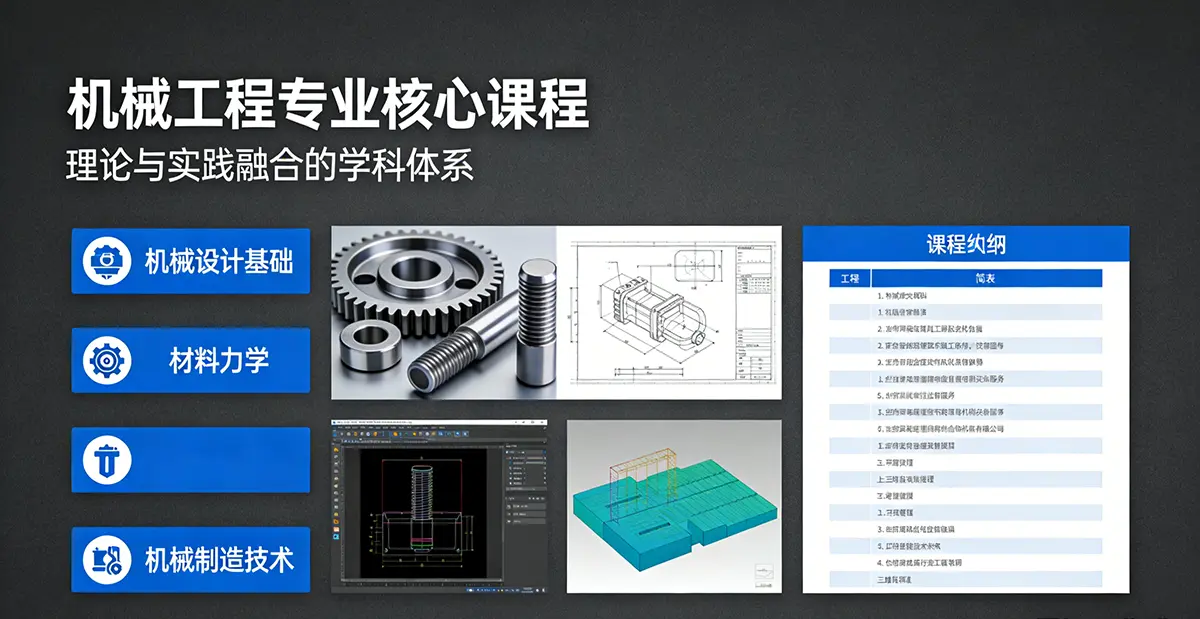
| Engineering Fundamentals | Theoretical Mechanics (Statics, Dynamics), Mechanics of Materials, Fluid Mechanics, Engineering Thermodynamics, Heat Transfer, Engineering Materials |
| Core Design & Manufacturing | Mechanics of Machinery, Mechanical Design, Interchangeability & Measurement Technology, Fundamentals of Manufacturing Technology (Metalworking Practice), Computer-Aided Design (CAD) |
| Control & Mechatronics | Electrical & Electronic Technology, Fundamentals of Control Engineering, Mechatronic Transmission & Control, Testing Technology, Sensors & Detection Technology |
| Professional Skills | Fundamentals of Computer-Aided Engineering (CAE) (e.g., Finite Element Analysis FEA), Hydraulic and Pneumatic Transmission, Mechanical System Modeling and Simulation, Mechanical Vibration |
| Frontiers and Interdisciplinary | Fundamentals of Robotics, Additive Manufacturing (3D Printing) Technology, Introduction to Microelectromechanical Systems (MEMS), New Energy Vehicle Technology |
3. Advanced Study Pathways for the Mechanical Engineering Major
Master's/PhD in Mechanical Engineering: Deepen expertise in specialized areas such as robotics, advanced manufacturing, vibration and acoustics, and new energy propulsion.
Interdisciplinary Master’s Degrees: Automation/Control Engineering (focus on system control and intelligent equipment); Materials Science and Engineering (focus on new materials in mechanical structures); Aerospace/Vehicle Engineering (advanced R&D within specific sectors); Industrial Engineering/Engineering Management (transition to production system optimization and management).
Master of Business Administration (MBA): Develops managers with a strong technical foundation.
Professional Certification: Registered Mechanical Engineer (varies by national or regional systems).
4. Career Paths and Positions for Mechanical Engineering Graduates
(Table structure remains unchanged, English text polished)
| Sector | Specific Positions and Directions |
| High-End Equipment & Product R&D | R&D Engineer (new machinery,
robotics, custom automation)
Structural Engineer (mechanical design, strength
analysis, optimization) |
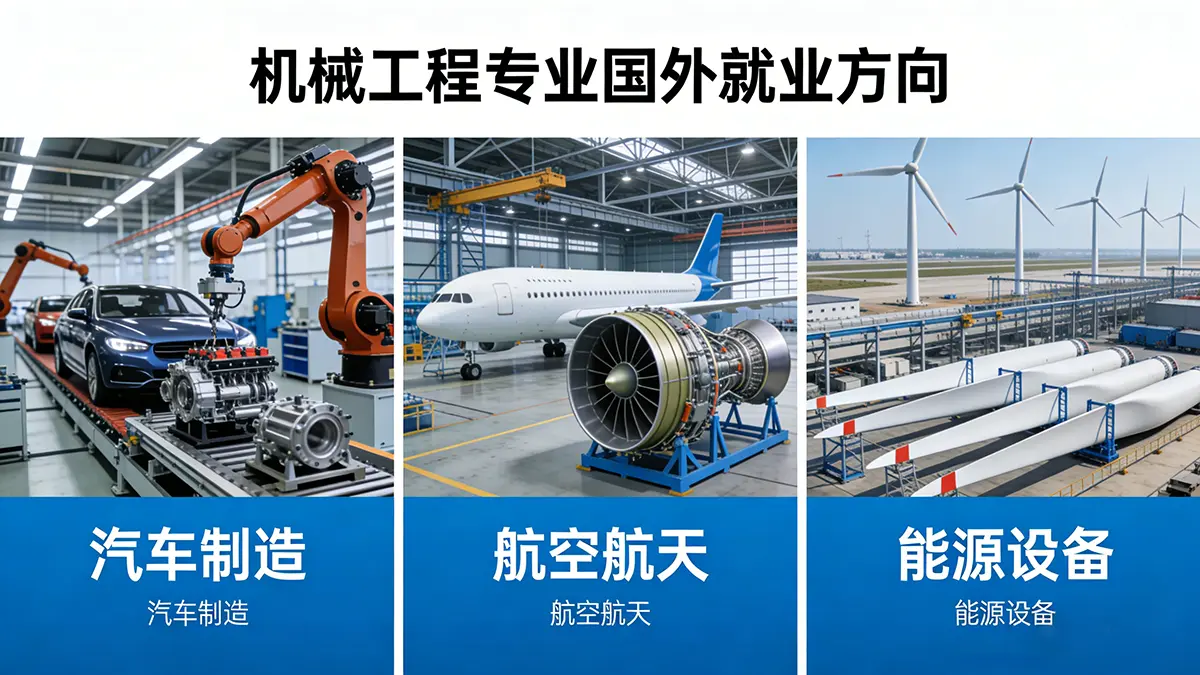
| Automotive & Transportation | Automotive Engineer (body, chassis,
powertrain, new energy systems design)
Mechanical Engineer in Rail Transit
& Aerospace |
| Advanced Manufacturing & Production | Manufacturing/Process Engineer
(process planning, fixture design, line optimization)
Quality Engineer
(quality control, inspection plans, reliability analysis) |
| Automation & Robotics | Automation Engineer (automated line design
& integration)
Robotics Application/Algorithm Engineer (robot
programming, debugging, integration) |
| Emerging & Interdisciplinary Fields | New Energy Engineer (wind, PV,
energy storage equipment)
Semiconductor Equipment Engineer (mechanical design
& support)
Medical Device Engineer (instrumentation, surgical robot
R&D)
Consumer Electronics Engineer (precision structural design) |
| Technical Services & Management | Technical Sales/Support Engineer
(pre- & post-sales support for complex equipment)
Project Manager
(engineering or product development project leadership) |
5. Employment Rates and Industry Trends for the Mechanical Engineering Major
Employment Rate Characteristics: Broad Demand, High Employment Rate: As a foundational engineering discipline, it enjoys stable long-term job market prospects, particularly in regions with robust manufacturing sectors. Moderate Starting Salary, High Experience Value: Undergraduate starting salaries are above average within engineering fields, with significant compensation growth tied to project experience and specialized skills (e.g., CAE proficiency, robotics expertise). Emphasis on Practical Experience Over Institutional Prestige: Employers highly value internship records, hands-on project involvement, and practical problem-solving abilities, making the prestige of one’s university comparatively less critical.
Industry Development Trends: Deep Integration of Intelligence and Digitalization: The convergence of digital twins, industrial IoT, and AI with mechanical systems is driving innovations like smart equipment and predictive maintenance. Green Manufacturing and Sustainability: Lightweight design, energy-efficient technologies, remanufacturing, and life-cycle assessments are becoming essential design considerations. Extreme and Precision Manufacturing: Fields like aerospace, semiconductors, and biomedicine create urgent demand for ultra-precision machining and micro/nano-fabrication technologies. Industrialization of Additive Manufacturing (3D Printing): The shift from prototyping to direct part production is revolutionizing the manufacture of customized and complex components. Expansion of Robotics Beyond Industrial Settings: Rapid growth in markets for collaborative robots, service robots, and special-purpose robotics.
6. Major Global Institutions Offering the Mechanical Engineering Major
| Country/Region | Representative Institutions (Leading Institutions in Mechanical Engineering) |
| United States | Massachusetts Institute of Technology, Stanford University, University of California, Berkeley, University of Michigan, Ann Arbor, Georgia Institute of Technology |
| Germany | RWTH Aachen University, Technical University of Munich, Karlsruhe Institute of Technology (renowned for rigorous engineering education) |
| United Kingdom | University of Cambridge, Imperial College London, University of Oxford |
| Switzerland | ETH Zurich, École Polytechnique Fédérale de Lausanne (EPFL) |
| Asia | Tsinghua University, Shanghai Jiao Tong University, Harbin Institute of Technology, National University of Singapore, University of Tokyo |
| Other | University of Waterloo (Canada – leading in co-operative education), Delft University of Technology (Netherlands) |
DisciplineMajor Recommendations
Ideal Candidates for the Mechanical Engineering Major
Individuals with a natural curiosity about how mechanical structures and devices function, coupled with a desire to disassemble and reassemble them. They should possess strong spatial visualization, logical reasoning, and practical hands-on skills. A genuine interest in solving concrete, real-world engineering problems is essential.
Core Competitiveness of the Mechanical Engineering Major
A solid foundation in mechanics and robust systems design capabilities. Proficiency in engineering software applications (mastery of at least one CAD and one CAE software). Design-for-manufacturability awareness and knowledge of production processes. The comprehensive ability to translate complex multidisciplinary challenges into concrete mechanical solutions.
Study Recommendations for the Mechanical Engineering Major
Prioritize Course Projects and Major Assignments: These are critical for transforming theoretical knowledge into practical design skills. Actively Participate in Academic Competitions: Contests like the “Challenge Cup,” Mechanical Innovation Design Competitions, or Formula Student provide valuable, accelerated project experience. Master Core Engineering Software: Develop proficiency in tools like SolidWorks/CATIA (CAD), ANSYS/ABAQUS (CAE), and Adams (dynamic simulation). Pursue High-Quality Internships: Gain first-hand exposure to real-world production processes and engineering challenges within industrial settings. Develop Programming Skills: Learning Python or C++ is crucial for automation, robotics, and CAE secondary development. Maintain Awareness of Emerging Technologies: Proactively follow technical advancements in smart manufacturing, robotics, new energy, and related fields.
Note: Some institutions may classify this major under different academic disciplines. Please refer to the specific classification used by your institution.
- The Previous Passage:Robotics(Robot.)_机器人学
- The Next Passage:Mechanical and Aerospace Engineering(Mech. Aerosp. Eng.)_机械和航空航天工程

Human Geography Major_Geography(Geog.)_人文地理
The Human Geography Major explores the complex relationships between human activities and space, cul···

Atmospheric Sciences(Atmos. Sci.)_大气科学
Atmospheric science is the study of phenomena and evolutionary patterns within Earth's atmospher···

Earth Sciences(Earth Sci.)_地球科学
The Earth Science major focuses on studying the Earth system and its interactions, providing a scien···

Ocean Sciences(Ocean Sci.)_海洋科学
PbootCMS是全新内核且永久开源免费的PHP企业网站开发建设管理系统,是一套高效、简洁、 强悍的可免费商用的···

