

World History(World Hist.)_世界历史
Time:2026-03-27 Visits:5
World History Major
The World History Major provides an integrative study of human societies across civilizations, focusing on global connections, exchanges, and comparative developments. This discipline cultivates macro-historical perspectives, cross-cultural analytical skills, and an understanding of transnational forces shaping the modern world. Graduates are prepared for diverse careers in education, international organizations, cultural institutions, and global business, where a deep historical understanding of international dynamics is essential. This guide details the program's core courses, advanced study options, employment paths, and leading global institutions.
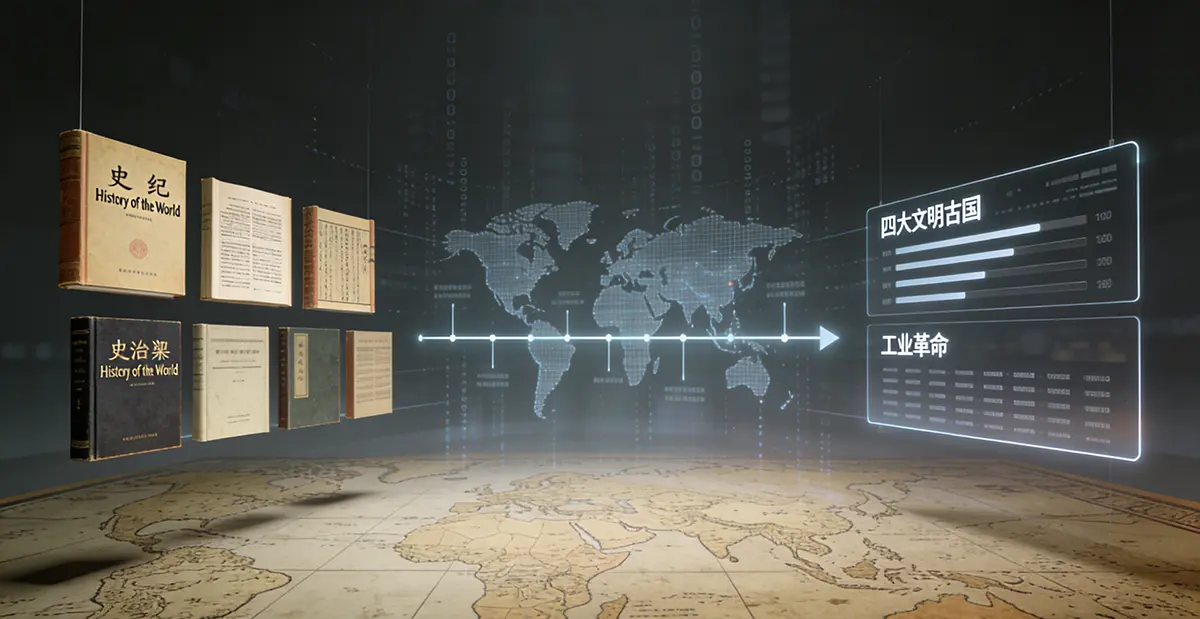
1. Introduction to the World History Major
The World History Major is a historiographical discipline dedicated to transcending the framework of national histories. It examines the overall development of human societies from a transregional, cross-civilizational, and global perspective. This major focuses on the exchanges, interactions, comparisons, and interconnections among different civilizations, exploring how global themes—such as empires, trade networks, species exchange, the dissemination of ideas, and war and peace—have shaped the modern world. The World History Major aims to cultivate students with a macro-historical vision, cross-cultural comprehension, critical comparative thinking, and the ability to analyze the transformations of complex global systems, thereby nurturing professionals with a profound international outlook and a sense of a shared future for humanity.
2. Core Courses in the World History Major
| Global History Theory and Methodology | Introduction to Global History, Global History Theory and Methodology, Comparative Historiography, Transnational History, World-Systems Theory, Network Analysis |
| Long-Term and Thematic Global Processes | Big History / History of Humanity, Agricultural Revolutions and Comparative Ancient Civilizations, The Silk Roads and Trans-Eurasian Exchange, The Columbian Exchange and Environmental History, Global History of Empires and Colonialism, Comparative Global Industrialization and Modernization, International History of the World Wars and the Cold War, Contemporary History of Globalization |
| Regional Civilizations and Interaction Studies | East Asian Civilizational Sphere and the World, South Asia and the Indian Ocean World, Middle Eastern and Islamic World History, African History and the World, European History and Its Global Impact, History of the Americas and the Pacific Rim |
| In-Depth Studies of Global Themes | Global History of Trade and Material Culture, History of Religious Diffusion and Intellectual Exchange, Technology Transfer and History of Knowledge, Global History of Disease and Medicine, Migration, Diasporas, and Transcultural Identity, History of International Organizations and Global Governance |
| Tools and Skills | World Historical Source Studies (Multilingual Documents), Professional Foreign Language (At Least One Non-Universal Language), Historical Geographic Information Systems (HGIS), Digital Humanities and Global Data Analysis, Academic Writing and International Scholarly Norms |
| Interdisciplinary and Frontier Studies | Maritime History / Global Maritime History, Environmental Global History, Global Urban History,
Gender and Global History, Postcolonial Studies, History of Global Capitalism |
3. Advanced Study Pathways for World History Majors
Master’s/PhD in Global History / World History: Become a professional world history researcher or university faculty member.
Master’s/PhD in Area and Country Studies: Deepen research on a specific region (e.g., East Asia, the Middle East, Africa) within a global perspective.
Master’s in International Relations / International Politics: Understand the formation of the contemporary international order through profound historical depth.
Master’s in Global Governance / Development Studies: Examine global issues such as poverty, inequality, and sustainable development from historical angles.
Master’s in Comparative Literature / Cultural Studies: Specialize in cross-cultural exchanges of ideas, arts, and texts.
Master’s in Cultural Heritage and Museum Studies (with a World Civilizations focus): Engage in cultural heritage preservation and exhibition curation within transnational contexts.
Master’s in Journalism and International Communication: Become a globally-minded investigative journalist or international news analyst.
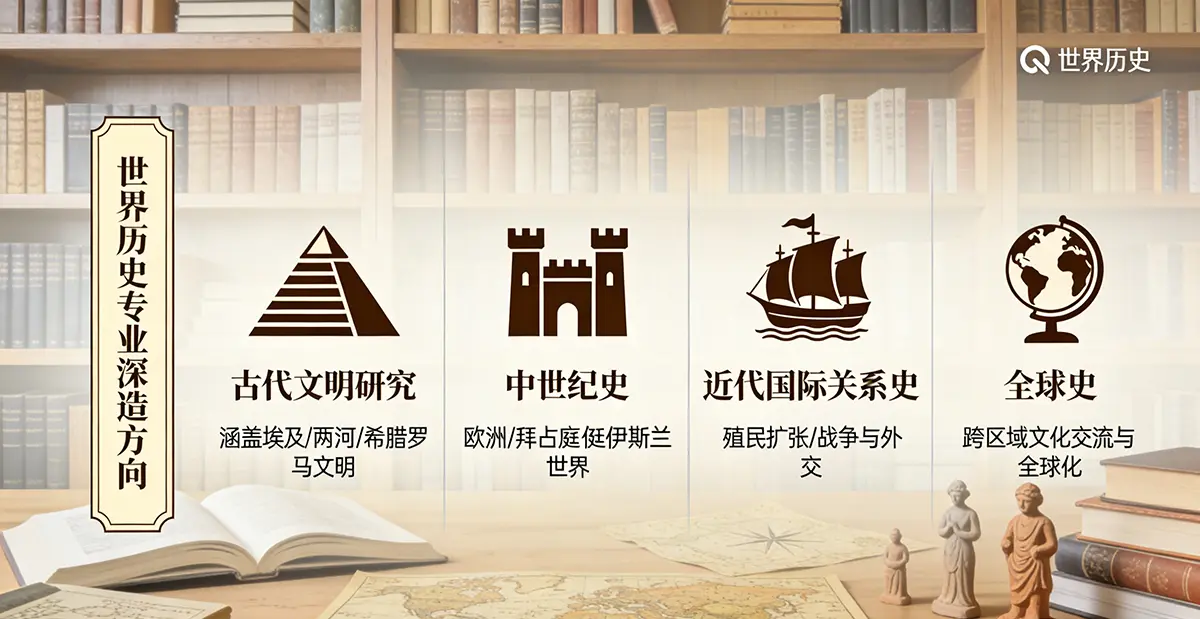
4. Career Paths and Positions for World History Majors
The global perspective, cross-cultural communication skills, and complex systems analysis capabilities cultivated by the World History Major give its graduates a distinct advantage in an increasingly globalized job market.
| Core Employment Fields | Typical Positions | Primary Responsibilities and Skill Application |
| Education and Research | University World History / Global History Instructor / Researcher | Engage in global history teaching and cutting-edge research, participating in international academic discourse. |
| Humanities Teacher at International / Bilingual Schools | Teach World History and Theory of Knowledge courses within international curricula like the IB and AP programs. | |
| International Organizations & Diplomacy | International Civil Servant (UN, UNESCO, WTO, etc.) | Conduct project research, policy analysis, and document drafting, requiring an understanding of diverse cultural backgrounds and historical contexts. |
| Diplomatic and Foreign Affairs Officer (Ministry of Foreign Affairs, Embassies/Consulates) | Provide historical background analysis on regions and countries, and participate in cultural exchanges and public diplomacy. | |
| Culture and Media | International News Editor / Commentator at Media Outlets | Produce in-depth background analyses on global current affairs and interpret the historical roots of international events. |
| Global Civilizations Curator at Museums / Exhibition Halls | Curate exhibitions centered on civilizational exchange and world art. | |
| International Copyright or Academic Editor at Publishing Houses | Plan the import or export of humanities and social sciences publications, assessing their global academic value. | |
| Business and Consulting | Market Strategy Analyst at Multinational Corporations (especially for emerging markets) | Analyze the history, culture, and social changes in target market countries to provide context for business decisions. |
| International Business Consultant | Provide consulting on cross-cultural compliance and the historical evolution of business environments for companies expanding overseas. | |
| Macro Researcher at International Investment Banks / Think Tanks | Analyze global economic and political trends from a long-term historical cycle perspective. | |
| Government & Public Policy | Policy Researcher at National Ministries / Provincial & Municipal Foreign Affairs Offices | Conduct foreign policy-related research and analyze the historical evolution of the international situation. |
| Global Governance / Regional & Country Researcher at High-Level Think Tanks | Conduct historical background and forward-looking research on major initiatives such as the Belt and Road Initiative and the Global Development Initiative. | |
| Emerging Fields | Digital Humanities Product Manager / Content Architect | Design content frameworks and narrative logic for global history databases, digital museums, and educational technology products. |
| Program Officer at International Non-Governmental Organizations (NGOs) | Responsible for the design and evaluation of transnational projects in areas like humanitarian aid and cultural preservation. |
5. Employment Rate and Industry Trends for World History Majors
Employment Rate Characteristics:
“High Competition for Top Platforms, Broad Applicability Across Fields”: Competition for relevant positions at top international organizations, research institutions, and multinational corporations is exceptionally fierce, demanding outstanding academic credentials, language proficiency, and internship experience. However, the professional competencies gained are widely applicable across numerous fields that require a global perspective and cross-cultural understanding.
“Language and Skills are Hard Currency”: Proficiency in English plus a non-universal language (e.g., French, Arabic, Spanish), combined with data analysis or project management skills, can significantly broaden employment prospects.
“Advanced Study and International Experience are Crucial”: Graduates with overseas exchange, study abroad, or internship experience at international institutions hold a significant advantage in the job market.
Industry Development Trends:
Global historical perspective becomes a "necessity" for high-level decision-making: When addressing global challenges such as climate change, public health crises, and geopolitical conflicts, policymakers increasingly require analysis based on long-term, cross-regional historical experience.
Surge in demand for regional and country studies: As China deepens its participation in global governance and Belt and Road cooperation, there is a huge gap for professionals proficient in the history, culture, and language of specific regions.
Deep integration of digital technology and global history research: Using big data and network analysis models to study global trade, intellectual dissemination, and migration patterns is at the forefront, also generating new skill demands.
Growing demand for global narratives in the public sphere: Museums, media, and educational products all require professional talent capable of providing diverse, balanced, and mutually enlightening global historical narratives that move beyond Eurocentrism.
The role of historical and cultural advisors in corporate globalization becomes prominent: Multinational corporations increasingly value a deep understanding of local historical contexts and socio-cultural dynamics in overseas investments, mergers and acquisitions, and brand building.
6. Major Global Institutions Offering the World History Major
| Country/Region | Representative Institutions (Leading or Distinctive in World History/Global History) |
| United States | Harvard University (integrates global history perspectives into regional studies), Columbia University (strengths in global intellectual history and international history), Princeton University, Georgetown University (excels in diplomatic and international relations history), University of California, Irvine (well-known World History program) |
| United Kingdom | University of Oxford (Centre for Global History), London School of Economics and Political Science (strengths in international economic history and global history), University College London, University of Warwick (Department of Global History and Culture) |
| Continental Europe | Freie Universität Berlin (global history research cluster), École Normale Supérieure de Paris, Leiden University (strengths in early modern global history and Asian studies), European University Institute (Florence) |
| Other Regions | Australian National University (strengths in Asia-Pacific history and global history), National University of Singapore (integration of Asian and global perspectives), University of Tokyo (global Japanese studies, East Asian history) |
| China | Peking University (Institute of World History, focusing on European/American history and global history theory), Fudan University (history of Sino-foreign relations, global intellectual history), East China Normal University (Cold War International History, Center for Global History Studies), Capital Normal University (Center for Global History Studies, notable for translation studies and theoretical research) |
Study and Development Recommendations for the World History Major
Ideal Candidates: Individuals with a strong interest in and curiosity about the cultures, civilizations, and their interconnections across the world. Those who are not satisfied with narratives confined to a single nation or region and aspire to understand the holistic picture and interactive networks of human history. People with outstanding foreign language learning abilities and a willingness for cross-cultural understanding, ready to think beyond their own cultural background. Those concerned with contemporary global issues (such as inequality, conflict, the environment) and who seek to find their roots and insights from history.
Core Competitiveness of the World History Major: Macro-Structural and Connective Thinking: The ability to situate discrete regional events within global networks and long-term processes, discerning their interconnections and commonalities. Cross-Cultural Comparison and Interpretation Skills: The capacity to understand the historical logic and value systems of different civilizations and conduct meaningful comparative analysis. Multilingual Archival Research Proficiency: The skill to use multiple language tools to acquire and critically engage with historical materials from diverse sources. Narrative Capacity for Complex Global Issues: The ability to construct clear, balanced, and in-depth global historical explanations for complex topics such as migration, trade, and the environment.
Study Recommendations for World History Majors: Master at Least "1+2" Languages: Ensure English proficiency at the academic research level and begin systematic study of one non-universal language early (chosen based on regional interest). Build a "Longitude-Latitude" Knowledge System: Develop depth in a specific thematic area ("longitude," e.g., trade, empires, religion) while achieving breadth across multiple regions ("latitude"), forming a grid-like understanding. Actively Utilize Digital Resources and International Academic Networks: Familiarize yourself with core databases and academic journals in global history, and follow the research of leading international scholars. Strive for International Practical Experience: Gain firsthand experience of cultural diversity and build a global network through overseas exchanges, summer schools, and internships at international organizations. Translate Historical Thinking into Problem-Solving Abilities: Consciously apply the analysis of historical patterns to contemplate current global challenges, and demonstrate this capability in internships and research.
Note: Some university programs may be categorized under different disciplines. Please refer to the specific institution’s actual classification.
- The Previous Passage:Japanese(Japanese Studies)_日语
- The Next Passage:Spanish(Spanish Studies)_西班牙语
Human Geography Major_Geography(Geog.)_人文地理
The Human Geography Major explores the complex relationships between human activities and space, cul···

Atmospheric Sciences(Atmos. Sci.)_大气科学
Atmospheric science is the study of phenomena and evolutionary patterns within Earth's atmospher···

Earth Sciences(Earth Sci.)_地球科学
The Earth Science major focuses on studying the Earth system and its interactions, providing a scien···
Ocean Sciences(Ocean Sci.)_海洋科学
PbootCMS是全新内核且永久开源免费的PHP企业网站开发建设管理系统,是一套高效、简洁、 强悍的可免费商用的···

