

Electronic and Information Engineering(Electron. Inf. Eng.)_电子信息工程学
Time:2026-03-08 Visits:3
Electronic Information Engineering Major
1. Introduction to the Electronic Information Engineering Major
The Electronic Information Engineering Major is a broad-based engineering discipline established to study the acquisition, processing, transmission, storage, and application of information. It integrates electronics, communications, computer, and signal processing technologies, combining hardware system design with software development to achieve efficient, reliable transmission and intelligent processing of various information types. This Major serves as a core pillar of the Information Technology (IT) industry, with applications spanning nearly all modern fields, including communications, consumer electronics, industrial control, and defense technology.
2. Major Courses in the Electronic Information Engineering Major
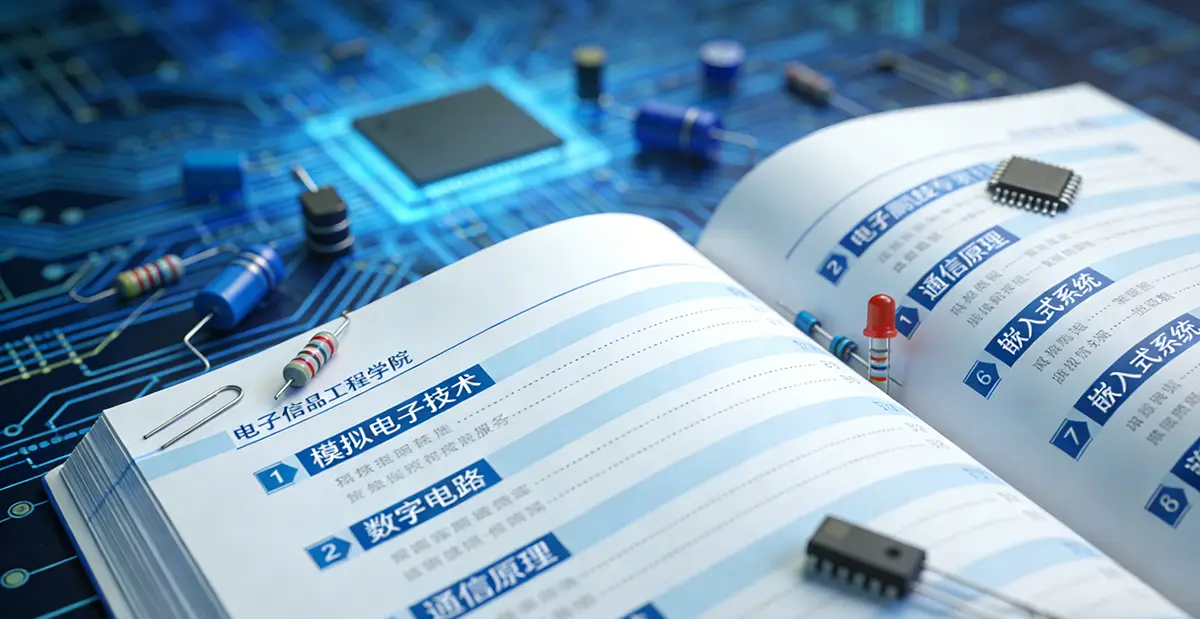
| Module Category | Core Courses |
| Mathematics and Circuit Fundamentals | Advanced Mathematics, Linear Algebra, Probability Theory and Mathematical Statistics, Complex Variables, University Physics, Circuit Analysis |
| Core Electronic Technology | Analog Electronics, Digital Electronics, High-Frequency Electronic Circuits, Electromagnetic Fields and Waves |
| Signal and Information Processing | Signals and Systems, Digital Signal Processing, Random Signal Analysis, Information Theory and Coding |
| Communication Technology | Communication Principles, Digital Communications, Mobile Communications, Fiber Optic Communications, Computer Networks |
| Computers and Control Systems | Microcomputer Principles and Interface Technology, Embedded Systems, Microcontroller Principles and Applications, Principles of Automatic Control, Data Structures |
| Design and Tools | EDA Technology (e.g., VHDL/Verilog), DSP Principles and Applications, PCB Design (Altium Designer, etc.), Matlab/Python Programming |
| Frontiers and Electives | Image Processing, Fundamentals of Machine Learning, Internet of Things Technology, RF Circuit Design, Introduction to Integrated Circuit Design |
3. Advanced Study Pathways for the Electronic Information Engineering Major
Master's/PhD in Electronic Information Engineering: Deepen research in areas such as communication and information systems, signal and information processing, and circuits and systems.
Communication Engineering: Focus on wireless communications, optical communications, and network technologies.
Electronic Science and Technology: Shift towards microelectronics, physical electronics, and integrated circuit design.
Control Science and Engineering: Emphasize system control, pattern recognition, and intelligent systems.
Computer Science and Technology: Develop towards software engineering, artificial intelligence, and computer networks.
Biomedical Engineering: Apply electronic information technology to medical devices and signal processing.
Interdisciplinary Fields: Fintech, quantum information.
4. Career Paths and Positions for the Electronic Information Engineering Major
Graduates of the Electronic Information Engineering Major enjoy exceptionally broad employment prospects. It is a versatile discipline in the information age, with distinct advantages in hardware-software integrated fields.
Telecommunications Industry (Operators, Equipment Manufacturers):
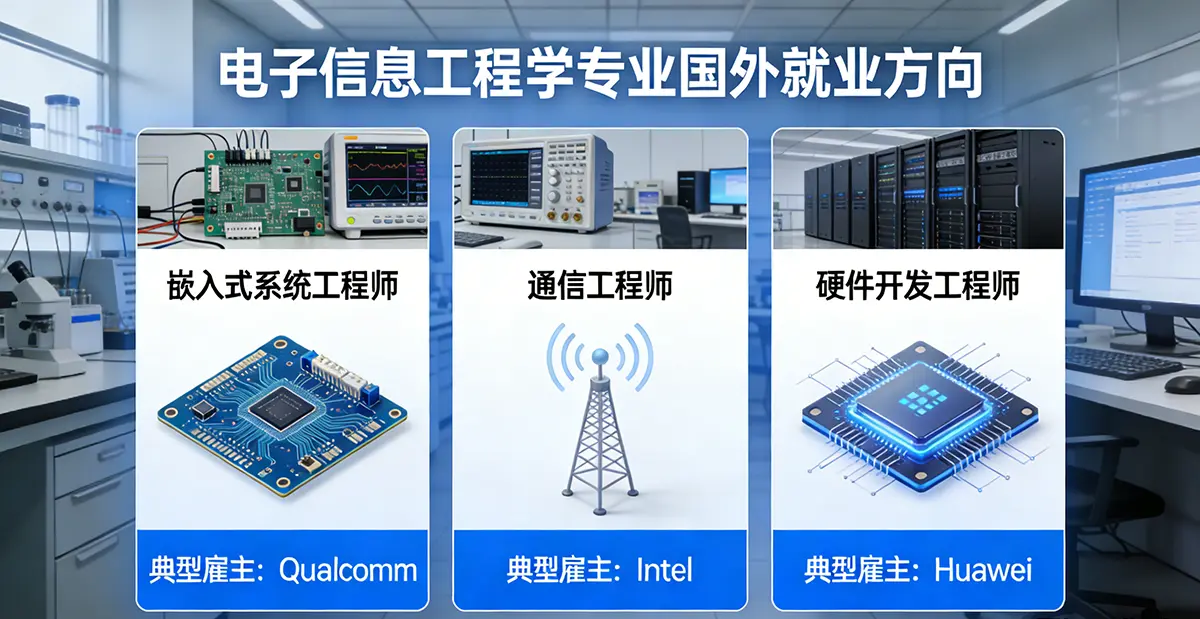
Huawei, ZTE, Ericsson, etc.: Communication Protocol Development Engineer, Base Station/Core Network Development Engineer, RF Engineer, Network Optimization Engineer.
China Mobile, China Unicom, China Telecom: Network Planning & Operations Engineer, Technical Support.
Consumer Electronics & Smart Hardware:
Mobile/Wearable Device Manufacturers (e.g., Xiaomi, OPPO, Apple, Samsung): Hardware Engineer, RF Engineer, Audio Engineer, Camera Module Engineer.
Smart Home/IoT Device Companies: Embedded Software Development Engineer, Wireless Connectivity Engineer.
Integrated Circuits & Semiconductors:
Chip Design Companies (e.g., HiSilicon, Unisoc, Qualcomm, NVIDIA): Digital/Analog IC Design Engineer, Verification Engineer, FPGA Development Engineer.
Chip Application & Solution Companies: Application Engineer, Field Application Engineer (FAE).
Automotive Electronics & Intelligent Driving:
Automotive Manufacturers/Tier 1 Suppliers: In-Vehicle Infotainment System Engineer, Autonomous Driving Perception (Radar/Camera) Hardware Engineer, Telematics Engineer.
Industrial Automation & Instrumentation:
Industrial Control Enterprises (e.g., Siemens, Inovance): Embedded Systems Engineer, Motion Control Engineer, Instrumentation R&D Engineer.
Internet & Software (Hardware-Oriented):
Cloud Computing/Data Centers: Server Hardware Engineer, Network Engineer.
Artificial Intelligence Companies: AI Algorithm Acceleration Engineer, Edge Computing Hardware Engineer.
Research Institutes & Defense Units: Engage in cutting-edge R&D for technologies like radar, aerospace electronics, and secure communications.
5. Employment Rate and Industry Trends for the Electronic Information Engineering Major
Employment Rate Characteristics
"High Demand, High Competition, High Salary Potential": The industry continues to grow with strong job demand, but rapid technological iteration requires high personal learning agility. Top-tier companies offer highly competitive compensation.
"Mastering Both Hardware and Software" is an Advantage: Students proficient in hardware principles and possessing strong programming skills are the most competitive.
High Geographic Concentration: Employment opportunities are heavily concentrated in electronics industry hubs like the Pearl River Delta (Shenzhen, Dongguan), Yangtze River Delta (Shanghai, Hangzhou, Nanjing), Beijing, Chengdu, and Wuhan.
Industry Development Trends
5G/6G and the Intelligent Internet of Everything: Deepening 5G deployment and 6G R&D are driving explosive growth in the Internet of Things (IoT), Industrial Internet, and Vehicle-to-Everything (V2X) communication.
Artificial Intelligence and Edge Computing: The deployment of AI algorithms at the device edge creates urgent demand for high-performance, low-power AI chips and edge computing devices.
Automotive Intelligence and Electrification: Smart cockpits, autonomous driving, and electric drive systems generate massive R&D opportunities for automotive electronics hardware and software.
Semiconductor Localization and Self-Reliance: Driven by national strategy, a significant talent shortage exists across the entire integrated circuit design, manufacturing, and equipment supply chain.
Satellite Internet and Integrated Air-Ground-Space Networks: The construction of low-Earth orbit satellite constellations is opening new dimensions for communication and information acquisition.
6. Major Global Institutions Offering the Electronic Information Engineering Major
| Country/Region | Representative Institutions (Top Institutions in Electronic Information Engineering)
| United States | Massachusetts Institute of Technology, Stanford University, University of California, Berkeley, University of Illinois at Urbana-Champaign |
| United Kingdom | University of Cambridge, Imperial College London, University of Oxford |
| Europe | ETH Zurich (Switzerland), Delft University of Technology (Netherlands), Technical University of Munich (Germany) |
| Asia | Tsinghua University, Shanghai Jiao Tong University, Zhejiang University, Beijing University of Posts and Telecommunications, University of Electronic Science and Technology of China, National University of Singapore |
| Other | University of Waterloo (Canada), University of Sydney (Australia) |
DisciplineMajor Recommendations
Ideal Candidates for the Electronic Information Engineering Major
Individuals with a curiosity for dissecting and understanding the inner workings of electronic devices, communication technologies, and smart hardware.
Those with strong logical thinking, abstract reasoning, and hands-on practical skills (e.g., soldering, debugging circuit boards).
Ability to adapt to fast-paced technological iteration and a willingness to learn new knowledge and tools.
Combine an engineer's rigor with an innovator's imagination.
Core Competencies of the Electronic Information Engineering Discipline
Solid theoretical foundation in analog/digital circuit design and signal processing.
Embedded system software/hardware development capabilities (e.g., ARM/MCU with RTOS/Linux).
Proficiency in at least one programming language (C/C++/Python) and EDA tools.
System-level design and problem-debugging skills.
Study Recommendations for the Electronic Information Engineering Major
Excel in foundational courses, especially Analog Electronics, Digital Electronics, and Signals and Systems: These are key differentiators for engineering proficiency.
Actively participate in competitions like electronic design contests, intelligent vehicle races, or FPGA innovation challenges: the gold standard for translating theory into project experience.
Master core toolchains: Altium Designer (PCB), Matlab/Simulink (simulation), Keil/IAR (embedded development), Vivado/Quartus (FPGA).
Build a personal project portfolio: Progress from simple microcontroller systems to complex communication/signal processing projects, managing code via GitHub.
Determine a technical stack focus early (e.g., communication algorithms, chip design, embedded development, RF/microwave) and pursue targeted, in-depth learning.
Follow hiring requirements and technical blogs from leading industry companies to stay attuned to cutting-edge technologies.
Note: Some institutions may categorize this program under a different discipline. Please refer to the specific classification of your chosen institution.
- The Previous Passage:Power Electronics Engineering(Power Electron. Eng.)_电力电子工程
- The Next Passage:Textile Science and Engineering(Text. Sci. Eng.)_纺织科学与工程

Human Geography Major_Geography(Geog.)_人文地理
The Human Geography Major explores the complex relationships between human activities and space, cul···

Atmospheric Sciences(Atmos. Sci.)_大气科学
Atmospheric science is the study of phenomena and evolutionary patterns within Earth's atmospher···

Earth Sciences(Earth Sci.)_地球科学
The Earth Science major focuses on studying the Earth system and its interactions, providing a scien···

Ocean Sciences(Ocean Sci.)_海洋科学
PbootCMS是全新内核且永久开源免费的PHP企业网站开发建设管理系统,是一套高效、简洁、 强悍的可免费商用的···

