

Nanoscience and Technology(Nanosci. Technol.)_纳米科学与技术
Time:2026-04-29 Visits:0
Nanoscience and Technology Major
Nanoscience and technology Major is a cutting-edge interdisciplinary field that manipulates matter at the atomic and molecular scale (1–100 nanometers) to create materials, devices, and systems with entirely novel properties and functions. Like a magical key, it unlocks the door to new mysteries of the material world. Here, extraordinary physicochemical phenomena—such as quantum effects and immense specific surface areas—take center stage, giving rise to applications that transcend conventional understanding.
If control science and engineering serve as the “brain” that endows systems with “intelligence,” then nanoscience and nanotechnology are the “seeds” providing revolutionary ‘materials’ and “components” for building future high-tech products. It profoundly impacts nearly every scientific and technological field, including electronics and information technology, biomedicine, energy, and the environment.

Introduction to Nanoscale Science and Technology Major: Reshaping the World at the Atomic Scale
The core of nanoscale science and technology lies in understanding, controlling, and fabricating matter at the nanoscale. This scale is unimaginably small (a human hair's diameter is about 80,000 nanometers), yet at this level, the physical, chemical, and biological properties of matter undergo fundamental changes.
Its core missions include:
- Understanding: Investigating quantum effects, surface effects, and small-size effects unique to materials at the nanoscale.
- Design: Engineering novel materials and structures at the atomic or molecular level to achieve desired functions.
- Fabrication: Developing techniques (e.g., lithography, self-assembly) to precisely manipulate and assemble atoms and molecules, constructing nanodevices.
- Application: Integrating nanomaterials and nanodevices into macroscopic systems to address major challenges in energy, health, information, and other fields.
Core Courses at International Institutions
Nanoscience and nanotechnology is a highly interdisciplinary field. Its curriculum spans physics, chemistry, biology, and engineering, aiming to build a comprehensive knowledge framework for students—from fundamental theories to cutting-edge applications.
| Course Stage | Core Course Examples | Learning Objectives |
| Foundational Disciplines | Quantum Mechanics, Solid-State Physics, Physical Chemistry, Organic Chemistry, Molecular Biology | Establish a solid foundation in mathematics, physics, chemistry, and biology to understand the underlying principles governing the nanoscale world. |
| Core Principles | Nanomaterials, Nanoelectronics, Nanophotonics, Nanobiology, Nanoscale Characterization Techniques (e.g., Scanning Probe Microscopy, Electron Microscopy) | Deepen knowledge of fundamental properties and behaviors of matter at the nanoscale, mastering key technologies to “visualize” and “manipulate” the nanoworld. |
| Manufacturing & Processing | Nanomanufacturing techniques, semiconductor processes, thin-film technology, self-assembly, cleanroom operations for micro/nano fabrication | Learn to fabricate nanostructures and devices in laboratory and industrial settings, experiencing the full process from design to finished product. |
| Design and Applications | Nanoelectromechanical Systems (NEMS), Nano-Device and System Design, Drug Delivery Systems, Nano-Energy Technologies, Computational Nanoscience | Apply nanoscale knowledge to specific domains, engaging in interdisciplinary system design and innovation. |
| Engineering and Computation | Engineering Programming, Computational Physics/Chemistry Methods, Computer-Aided Design of Nanomaterials | Master tools for computer simulation and design of nanostructures and processes. |
Advanced Study Directions in Nanoscience and Technology Major
Due to nanotechnology's interdisciplinary nature, master's or doctoral research directions are highly diverse and typically deeply integrated with specific application fields:
- Nanomaterials: Focuses on the synthesis, structural characterization, and performance optimization of novel nanomaterials (e.g., graphene, quantum dots, two-dimensional materials, nanotubes).
- Nanoelectronics and Nanophotonics: Investigating the use of nanoscale effects to create higher-performance, lower-power electronic and optoelectronic devices, such as nanotransistors, quantum computing chips, and metamaterials.
- Nanobiology and Nanomedicine: Exploring nanoscale processes within biological systems and developing nanotechnologies for disease diagnosis (e.g., nanoprobes, biosensors), therapy (e.g., targeted drug delivery, photothermal therapy), and regenerative medicine.
- Nano-Energy and Environmental Technologies: Developing nanomaterials for efficient energy conversion (e.g., next-generation solar cells, fuel cell catalysts) and storage (e.g., high-performance batteries, supercapacitors), along with environmental nanotechnologies for pollution detection and remediation.
- Nano-Manufacturing and Characterization: Focusing on next-generation nanofabrication techniques (e.g., extreme ultraviolet lithography, nanoimprinting) and ultra-high-precision characterization tools.

International Career Paths and Positions
Graduates of the Nanoscience and Technology program are highly competitive, versatile professionals whose career opportunities span high-tech industries, research institutions, and government agencies. With the acceleration of technology commercialization, demand for these talents continues to rise.
| Industry Sector | Common Positions | Brief Job Responsibilities |
| Semiconductor & Integrated Circuits | Semiconductor Process Engineer, Nanomanufacturing Engineer, Device R&D Engineer | Participate in developing and optimizing advanced chip manufacturing processes at companies like TSMC, Intel, and Samsung. |
| Electronics & Information Industry | Display Materials Engineer, Memory Device Engineer, Quantum Computing Researcher | Develop core materials and devices for next-generation display technologies (e.g., OLED, Micro-LED), high-density storage, or quantum computing. |
| Biomedical and Healthcare | Nanomedicine R&D Specialist, Biosensor Engineer, IVD Reagent R&D Engineer | Develop targeted drug delivery systems, high-sensitivity diagnostic reagents, or medical imaging contrast agents at pharmaceutical or biotech companies. |
| New Materials and Energy | Battery Materials Engineer, Catalyst R&D Specialist, Composite Materials R&D Engineer | Develop high-performance battery materials for electric vehicles, efficient energy conversion materials, or lightweight, high-strength structural materials. |
| Research and Academia | Postdoctoral Researcher, University Professor, National Laboratory Researcher | Conduct cutting-edge fundamental or applied research at universities or national research centers (e.g., Lawrence Berkeley National Laboratory). |
| Instrumentation Manufacturing | Application Scientist, Characterization Technology Specialist | Provide application development and customer support for high-end scientific instruments like electron microscopes and scanning probe microscopes for companies such as Thermo Fisher Scientific and Zeiss. |
International Employment Rate and Development Trends
Employment Rate: Graduates in this field enjoy high employment rates, particularly in hot industries like semiconductors, biopharmaceuticals, and new energy. For example, the University of Waterloo in Canada reports a 96% employment rate for its nanotechnology engineering graduates within six months of graduation, far exceeding the local average. U.S. Bureau of Labor Statistics data also indicates that related positions (e.g., materials engineers) offer substantial median salaries (e.g., over $93,000/year) and promising career prospects.
Industry Development Trends:
- Accelerated Industrialization: Nanotechnology is transitioning from laboratory research to large-scale industrial applications. The global nanotechnology market is projected to grow from $91.18 billion in 2024 to $332.73 billion by 2032. The National Science Foundation has also forecasted that nanotechnology-related markets could reach trillion-dollar scale, creating millions of jobs.
- Underpinning Core Technological Innovation: Nanotechnology serves as the foundational pillar for disruptive technologies in the post-Moore's Law era, including sub-2nm semiconductor processes, quantum computing, next-generation energy storage batteries (e.g., solid-state batteries), and precision medicine.
- Deepening Cross-Disciplinary Integration: Future breakthroughs will increasingly emerge at the intersections of nanotechnology with artificial intelligence, synthetic biology, quantum information science, and other fields.
- Sustainability takes center stage: Developing clean energy, efficient energy storage, plastic degradation, and pollutant treatment solutions through nanotechnology is crucial for addressing global climate change and environmental pollution challenges.
Ideal Candidates and Core Competencies for Nanoscience and Technology Major
You may excel in nanoscience and technology if you possess these traits:
- Strong interdisciplinary curiosity: Unsatisfied with single-discipline knowledge, eager to explore unknowns at the intersection of physics, chemistry, biology, and engineering.
- Solid abstract reasoning and mathematical foundation: Requires understanding and applying abstract theories like quantum mechanics to guide practical work.
- Exceptional hands-on skills and patience: Working at the nanoscale demands operating precise, expensive equipment with high concentration and meticulous experimental habits.
- Visionary innovator: Believes that rearranging atoms can create unprecedented materials and machines to solve humanity's greatest challenges.
Core Competency: Your core value lies in the ability to “design” and “build” at the atomic and molecular scale. You transcend traditional disciplinary boundaries, transforming fundamental scientific discoveries into revolutionary materials, devices, and system solutions.
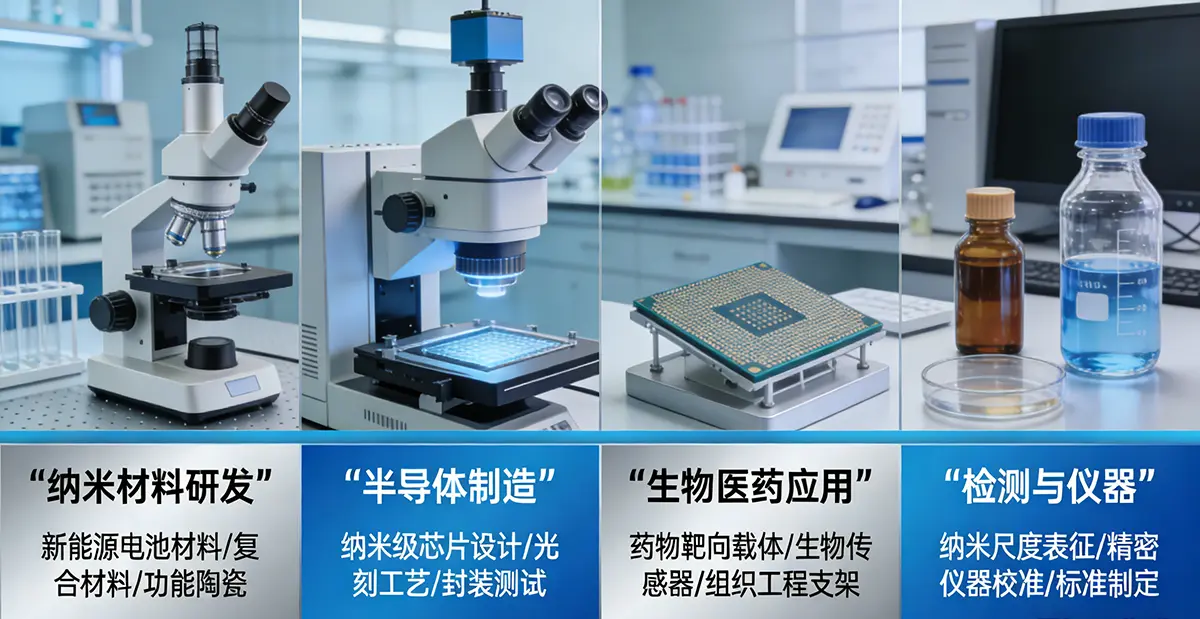
Leading Institutions Worldwide
(Selected Schools - Listed in no particular order)
Nanoscience and nanotechnology are typically offered as independent departments, research centers, or as interdisciplinary programs within physics, chemistry, materials science, electronics, and other departments. Leading institutions globally include:
| Country/Region | Representative Institutions |
| United States | Massachusetts Institute of Technology, Stanford University, University of California, Berkeley, University of California, Los Angeles, Rice University, Northwestern University |
| China | Tsinghua University, Peking University, University of Science and Technology of China, Nanjing University, Fudan University |
| Singapore | National University of Singapore, Nanyang Technological University |
| Switzerland | Swiss Federal Institute of Technology Zurich, École Polytechnique Fédérale de Lausanne |
| Europe | Delft University of Technology, Royal Institute of Technology (KTH), Technical University of Munich, Lund University |
| Canada | University of Toronto, University of British Columbia, University of Waterloo |
Recommended Pathways for Studying Nanoscience and Technology Major
1. Undergraduate Stage: Build a broad knowledge foundation and engage in research early
- Core: Master the fundamentals of physics, chemistry, biology, and mathematics. Simultaneously grasp the basic principles and characterization methods of nanoscience through core courses.
- Practice: Actively seek laboratory opportunities, even if only as an assistant. Gain hands-on experience in synthesizing nanomaterials, fabricating devices, or operating characterization equipment. Utilize summer internships to explore industrial applications of nanotechnology.
2. Master's Stage: Focus on a specialized direction and enhance engineering and R&D capabilities
- Objective: Select an application field (e.g., nanoelectronics, nanomedicine, nanoenergy) aligned with your interests for in-depth study. Master at least one nanofabrication or characterization technique proficiently.
- Advancement: Develop independent problem-solving skills for complex engineering and scientific challenges by participating in a full-scale research project or industry collaboration. Elective courses may include computational modeling or advanced device physics.
3. Doctoral & Postdoctoral Stages: Tackle Frontier Scientific Problems, Become a Domain Expert
- Positioning: If you crave exploring the unknown and aspire to become a top expert in a specialized field, the doctoral stage is essential. Under your advisor's guidance, you will conduct years of in-depth research on a specific, challenging scientific or technical problem (e.g., topological quantum computing, atomic-level precision manufacturing, bionic nanopore sequencing).
- Future: PhD graduates are highly sought after by R&D centers of high-tech companies (e.g., IBM Research, Intel, Pfizer), national laboratories, and top universities. They stand at the forefront of driving generational technological transformations.
- The Previous Passage:Quantum Science and Engineering(Quantum Sci. Eng.)_量子科学与工程
- The Next Passage:Energy Science and Engineering(Energy Sci. Eng.)_能源科学与工程
Human Geography Major_Geography(Geog.)_人文地理
The Human Geography Major explores the complex relationships between human activities and space, cul···

Atmospheric Sciences(Atmos. Sci.)_大气科学
Atmospheric science is the study of phenomena and evolutionary patterns within Earth's atmospher···
Earth Sciences(Earth Sci.)_地球科学
The Earth Science major focuses on studying the Earth system and its interactions, providing a scien···
Ocean Sciences(Ocean Sci.)_海洋科学
PbootCMS是全新内核且永久开源免费的PHP企业网站开发建设管理系统,是一套高效、简洁、 强悍的可免费商用的···

