

Financial Engineering(Financ. Eng.)_金融工程
Time:2026-04-13 Visits:4
Financial Engineering Major
The Financial Engineering Major integrates finance, mathematics, and computer science to design innovative financial solutions. This overview details its rigorous curriculum in quantitative methods and programming, explores high-demand careers in buy-side/sell-side firms, analyzes key industry trends like AI integration, and lists leading global graduate programs for aspiring quants.

1. Introduction to the Financial Engineering Major
The Financial Engineering Major is a highly interdisciplinary and applied field of study that synthesizes finance, mathematics, statistics, and computer science. It employs mathematical modeling, quantitative analysis, and programming techniques to design, develop, and innovate financial products, solve complex financial problems, and implement effective risk management strategies. At its core, the Financial Engineering Major applies an engineering mindset—encompassing design, construction, and testing—to address challenges within finance, which is why it is also termed “Quantitative Finance,” “Financial Mathematics,” or “Computational Finance.”
2. Core Curriculum of the Financial Engineering Major
| Module Category | Core Courses | Description and Objectives |
| Foundations of Finance | Investments, Corporate Finance, Asset Pricing, Derivatives Pricing, Fixed Income Securities | Establishes the core framework for financial markets, valuation, and decision-making, mastering key engineering tools like derivatives. |
| Mathematics & Statistics Core | Probability & Statistics, Stochastic Processes, Time Series Analysis, Numerical Methods | Provides the foundation for modeling uncertainty, describing price dynamics, and solving models via computational techniques. |
| Programming & Computing | Python, C++, Data Structures & Algorithms, Machine Learning/AI Applications | Masters dominant programming languages for data analysis and modeling, optimizes performance, and applies cutting-edge AI techniques. |
| Core FE Applications | Financial Risk Management, Quantitative Trading Strategies, Financial Modeling & Monte Carlo Simulation, Case Studies/Capstone Projects | Learns risk measurement and management, designs and backtests quantitative strategies, solves complex problems via simulation, and completes integrative practical projects. |
3. Advanced Study and Career Paths for the Financial Engineering Major
Advanced Study Pathways:
1) Master’s/PhD: Most graduates pursue a Master’s in Financial Engineering, Financial Mathematics, Quantitative Finance, or Business Analytics. A PhD targets top-tier quantitative research or academia.
2) Interdisciplinary Fields: Computer Science (algorithms), Data Science, Statistics.
Career Paths and Positions:
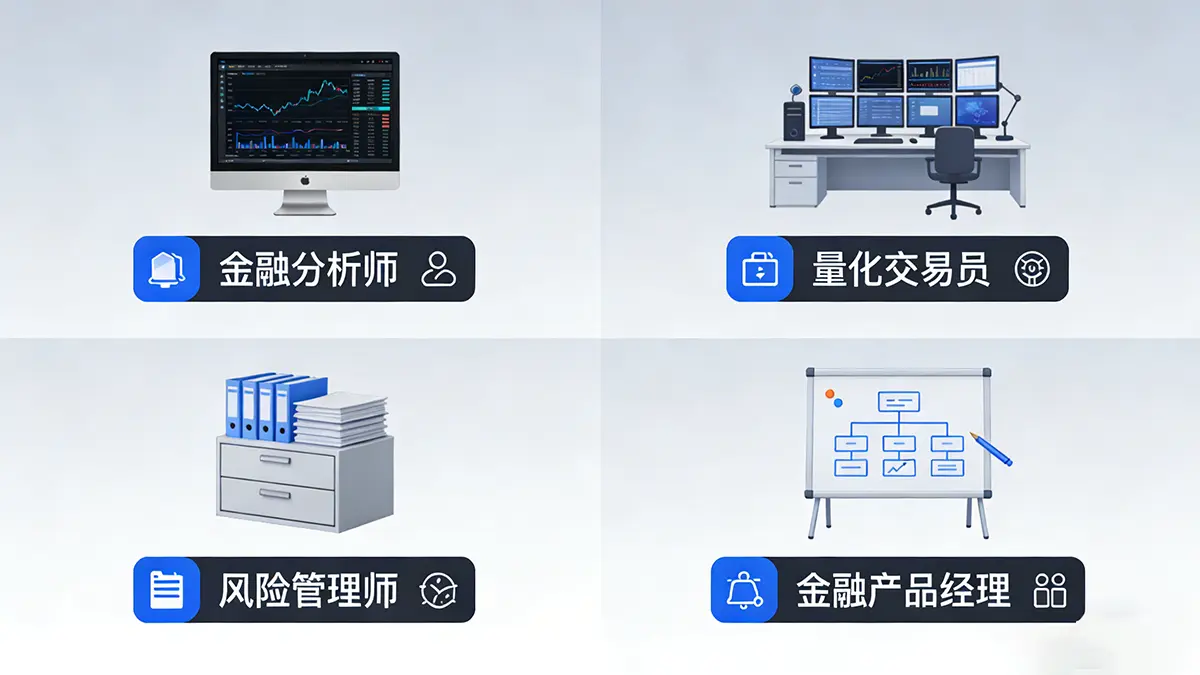
3) Buy-Side: Hedge Funds (Quantitative Researcher, Alpha Researcher); Asset Management Firms (Quantitative Analyst, Risk Analyst).
4) Sell-Side: Investment Banks (Structured Product Design, Derivatives Trading); Commercial Banks (Financial Markets, Advanced Risk Model Development).
5) FinTech Companies: Credit Scoring Model Development, Algorithmic Trading Systems, Cryptocurrency Quantitative Analysis.
6) Corporate & Public Sectors: Corporate Treasury (Risk Management); Exchanges, Regulatory Agencies (Technical or Risk Departments).
Common Job Titles: Quantitative Analyst, Financial Engineer, Risk Analyst, Quantitative Trader.

4. Employment and Industry Trends for the Financial Engineering Major
Employment & Compensation: As a high-barrier field, graduates from top Financial Engineering Major programs typically enjoy high employment rates (>90%) and starting salaries significantly above the financial industry average. Competition is fierce, with heavy emphasis on university prestige, technical prowess, and internship experience.
Industry Trends:
1) Deep Integration of AI & ML: Machine and deep learning models are increasingly supplanting traditional statistical models for forecasting, trading, and risk control.
2) Rise of Alternative Data: Non-traditional sources like satellite imagery and social media sentiment are new frontiers for quantitative research.
3) Digital Assets & DeFi: Spawns new demand for quantitative trading, market making, and risk management.
4) Compliance & RegTech: Tighter global regulations fuel demand for sophisticated risk models and stress testing.
5) Technology as the Norm: Programming and data processing skills are now essential core competencies for practitioners.
5. Leading Global Institutions
(Some universities are shown - ranking is not in order. Top Program Examples)
| Country/Region | Representative Institutions (Notable Financial Engineering Programs) |
| United States | Princeton University, UC Berkeley, Carnegie Mellon University, Columbia University, New York University, MIT |
| United Kingdom | University of Oxford, Imperial College London, London School of Economics |
| Europe | ETH Zurich, HEC Paris |
| Asia | National University of Singapore / Nanyang Tech, University of Hong Kong / HKUST, Tsinghua University, Peking University |
| Canada | University of Toronto, University of Waterloo |
DisciplineMajor Recommendations
Ideal Candidates: Individuals with a strong passion for financial markets, coupled with exceptional mathematical aptitude, logical reasoning, programming skills, and the capacity to thrive in high-pressure, fast-paced environments.
Core Competencies: A synergistic combination of “financial intuition, mathematical foundation, and programming implementation” is non-negotiable.
Recommended Learning Path:
1. Solidify mathematical and statistical foundations with excellent academic performance.
2. Master at least one programming language thoroughly (Python is the essential starting point).
3. Accumulate practical financial knowledge through certifications (CFA/FRM) or relevant internships.
4. Engage in hands-on practice via Kaggle competitions or independent quantitative strategy backtesting projects.
5. Proactively target and secure internships at premier financial institutions early.
The Financial Engineering Major leads to a field in constant evolution, demanding a commitment to lifelong learning.
Note: Program categorization varies by institution. Please refer to the specific discipline classification used.
- The Previous Passage:Environmental Science and Engineering(Env. Sci. & Eng. 或 ESE)_环境科学与工程
- The Next Passage:Cardiovascular Science(Cardiovasc. Sci.)_心血管科学

Human Geography Major_Geography(Geog.)_人文地理
The Human Geography Major explores the complex relationships between human activities and space, cul···

Atmospheric Sciences(Atmos. Sci.)_大气科学
Atmospheric science is the study of phenomena and evolutionary patterns within Earth's atmospher···

Earth Sciences(Earth Sci.)_地球科学
The Earth Science major focuses on studying the Earth system and its interactions, providing a scien···

Ocean Sciences(Ocean Sci.)_海洋科学
PbootCMS是全新内核且永久开源免费的PHP企业网站开发建设管理系统,是一套高效、简洁、 强悍的可免费商用的···

